If you’re a small business owner, an SEO audit can feel intimidating—like you need a “technical brain” to even start. The truth: you can audit a lot yourself with simple checks and free tools. But there are also parts where hiring a pro saves time (and avoids costly mistakes).
This guide breaks down what you can DIY, what’s worth outsourcing, and a simple way to turn an audit into a clear action plan.
What an SEO audit actually is (in plain English)
An SEO audit is a structured check of your website to find:
- Why you’re not ranking (or why traffic dropped)
- What’s blocking Google from crawling/indexing correctly
- Which pages should be improved first to get the most leads
- What technical or content fixes will have the biggest impact
Think of it like a “website health check,” but focused on search visibility and conversions.
The quick decision: DIY audit or hire help?
DIY makes sense if…
- You’re a local business and need a basic SEO tune-up
- You can follow checklists and do small edits (titles, content, images)
- You want clarity before spending money on SEO services
Hire out (or at least get a pro review) if…
- Your site is ecommerce, has lots of pages, or multiple languages
- You had a traffic drop and don’t know why
- You suspect indexing/crawl issues, redirect problems, or canonical errors
- You’re investing in content/ads and want to stop wasting budget
- Your site is slow and you don’t know what to fix without breaking things
What you can DIY in an SEO audit
1) Basic setup checks (high impact, easy)
DIY tasks
- Confirm you have Google Search Console and Google Analytics set up
- Check that you’re tracking form submissions / calls / purchases
- Verify your sitemap exists and is submitted
What you’re looking for
- Are pages being indexed?
- Are there errors or warnings?
- Are people actually converting from organic traffic?
2) On-page SEO (very DIY-friendly)
DIY tasks
- Review your top pages (homepage + main services) for:
- One clear H1 per page
- A strong meta title (includes the main keyword + location if relevant)
- A helpful meta description (clear offer + trust + CTA)
- Clean URLs (short, readable)
- Internal links to related services and contact page
Quick win rule
If a page is important to your business, it should answer:
- What you do
- Who it’s for
- Where you serve
- Why you’re better/different
- How to contact/book/buy
3) Content & keyword alignment (DIY with common sense)
DIY tasks
- Make a list of your money pages (the ones that should bring leads)
- For each one, confirm it targets one main search intent:
- “Webmaster services Montreal”
- “WordPress maintenance Canada”
- “Shopify speed optimization”
- Add missing sections: pricing approach, process, FAQs, examples, and proof
What to avoid
- One “Services” page trying to rank for everything
- Thin pages that don’t answer real questions
4) Local SEO (DIY + very important for small businesses)
DIY tasks
- Optimize your Google Business Profile:
- Correct categories, services, business description
- Photos + posts + Q&A
- Ensure your NAP is consistent:
- Name / Address / Phone across your site + directories
- Add a location/service area section on key pages
- Collect reviews regularly (and respond to them)
5) Basic technical SEO checks (some DIY, some “careful”)
DIY tasks
- Check:
- Mobile friendliness
- Broken links (404s)
- Duplicate pages (common with tags/filter pages)
- Missing image alt text on key pages
- Page speed (at least identify which pages are slow)
You can often identify issues yourself—but fixing them safely is where pros help.
What’s worth hiring out (and why)
1) Indexing, crawling, and site architecture issues
Hire help if:
- Important pages aren’t indexed
- You see weird duplicates (http/https, www/non-www, parameter pages)
- You have redirect chains or lots of “Excluded” pages in Search Console
These problems can silently block growth even if your content is good.
2) Speed & Core Web Vitals fixes
DIY can tell you what’s slow. A pro can tell you what to remove/change without breaking the site.
A speed specialist can:
- Fix render-blocking scripts
- Optimize themes/plugins/apps
- Improve caching, CDN, image delivery, fonts
- Address layout shift (CLS) and interaction delays (INP)
3) Advanced audits for ecommerce / Shopify / large WordPress sites
Once you have:
- Many product pages, collections, filters
- Multiple languages (WPML)
- Complex navigation and internal linking needs
…you’ll benefit from someone who can audit templates, indexing rules, schema, and internal linking at scale.
4) Link audits and penalty recovery
If you suspect spammy backlinks or a sudden drop, get help. You don’t want to “disavow” randomly or make decisions based on guesswork.
A simple audit workflow you can follow (DIY)
Step 1: Pick your top 5–10 “money pages”
Examples:
- Homepage
- 2–4 core service pages
- Contact/booking page
- Top blog posts that bring traffic
Step 2: Score each page (1–5) on:
- Search intent match
- Clarity & trust (proof, testimonials, examples)
- On-page basics (title/H1/internal links)
- Conversion (CTA, forms, phone, next steps)
- Speed/mobile experience
Step 3: Fix in this order (highest ROI first)
- Indexing/crawl blocks (if any)
- Main service pages (titles, content, CTAs)
- Local SEO / Google Business Profile
- Speed improvements on top pages
- Content expansion + new content plan
Common “audit findings” for small businesses (and quick fixes)
- Service pages too thin → Add FAQs, process, proof, examples, stronger CTA
- One page targeting too many keywords → Split into focused service pages
- Blog posts get traffic but no leads → Add clear CTAs + internal links to services
- Slow pages → Compress images, reduce heavy plugins/apps, improve caching
- No local signals → Add service area, local keywords, GBP optimization
- No tracking → Set up conversion tracking so SEO improvements are measurable
How often should a small business do an SEO audit?
A practical cadence:
- Mini-audit monthly: check Search Console errors + top pages + conversions
- Full audit quarterly: deeper review of content, technical, and local SEO
- After major changes: redesign, theme change, migration, new plugins/apps
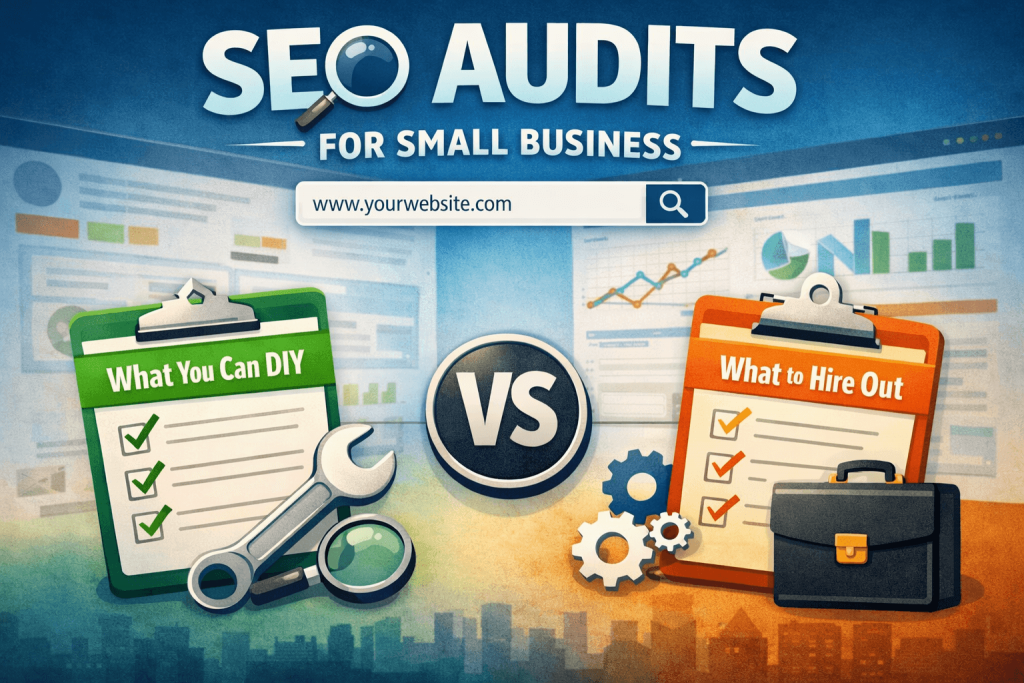
DIY vs Hire: the “hybrid” approach I recommend
Many small businesses get the best results by doing this:
- DIY audit (to understand your site and prioritize)
- Hire a pro for the risky/high-impact parts:
- technical fixes, speed, indexing, architecture
- DIY ongoing improvements:
- content updates, new pages, blog posts, reviews, internal linking
It keeps costs controlled and builds momentum.
FAQ
What is included in an SEO audit?
Typically: technical checks (indexing, speed, crawl), on-page review, content analysis, local SEO review, and an action plan.
Can I do an SEO audit myself?
Yes—especially for on-page, local SEO, and content. The biggest risk is implementing technical fixes without understanding side effects.
How long does an SEO audit take?
A basic DIY audit can take a few hours. A detailed professional audit usually takes longer because it includes deeper technical checks and documentation.
What should I fix first after an SEO audit?
Start with anything that blocks indexing/crawling, then optimize your main service pages, then improve speed and content depth.
Do I need an SEO audit if I’m running Google Ads?
Yes. Ads can hide website problems. A weak landing page or slow site can waste ad spend and reduce conversions.