
When you need website help, you’ll usually end up choosing between two paths:
- Agency packages (a monthly plan with defined deliverables and a team behind it)
- On-demand webmaster support (flexible help when you need it—hourly or a small retainer)
Both can be the right choice. The best fit depends on your goals, your budget, and how “mission-critical” your website is.
This guide breaks it down in a practical way—plus real-world examples so you can decide quickly.
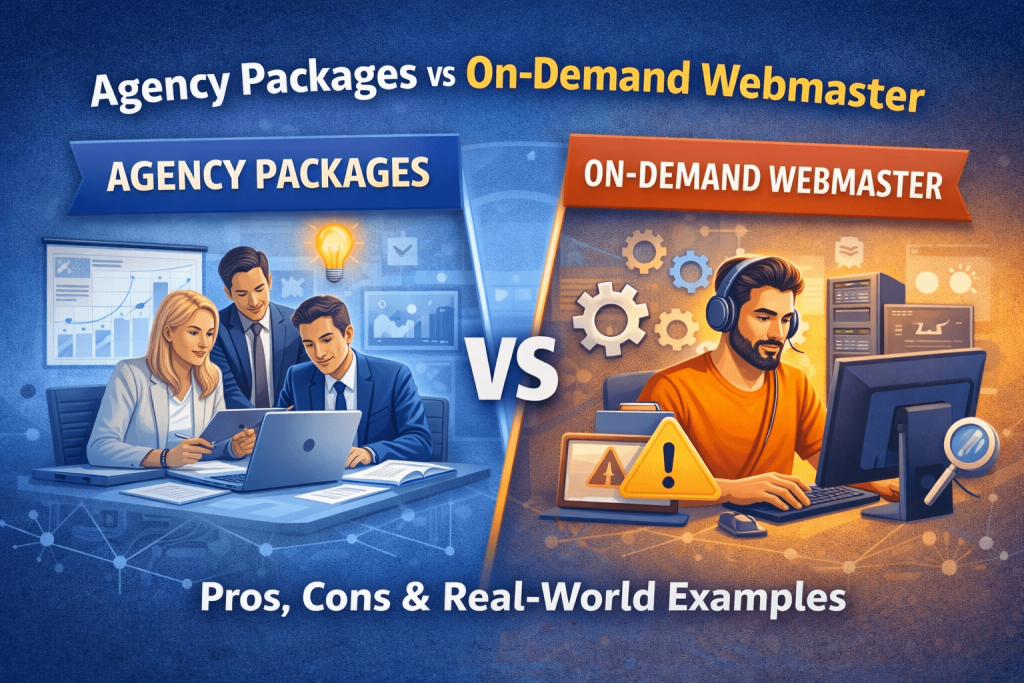
What “Agency Packages” usually mean
Agency packages are typically built around predictable monthly work. Depending on the agency, packages might include:
- Monthly content updates (X pages or X hours)
- Design tweaks
- SEO tasks (reporting, optimization, link building, content)
- Paid ads management (sometimes)
- Strategy calls, reporting dashboards, and project management
- Access to multiple specialists (designer, developer, SEO, PPC)
You’re paying for a system: processes, team coverage, and ongoing execution.
What “On-Demand Webmaster” usually means
An on-demand webmaster is usually focused on keeping the site healthy and working, plus quick improvements. Common support includes:
- Updates, backups, security monitoring
- Fixing bugs, plugin conflicts, broken layouts
- Speed improvements and Core Web Vitals fixes
- Technical SEO fixes (indexing, redirects, broken links, schema basics)
- Small content edits (new sections, text swaps, images, forms)
- Shopify/WooCommerce troubleshooting (emails, checkout, shipping rules)
You’re paying for expert hands-on support—often faster and more flexible for day-to-day needs.
Quick comparison
Agency Packages: Pros
- Team coverage: If one person is away, someone else can usually pick it up.
- Broader skill set in one place: Design + dev + SEO + ads (if needed).
- Structured execution: Regular deliverables, reporting, and planning.
- Best for growth programs: Especially if content + SEO + ads are ongoing.
Agency Packages: Cons
- Higher overhead: You pay for account management, meetings, PM tools, and internal coordination.
- Slower for small fixes: Minor tasks can enter a queue (ticketing, approvals).
- Package limits: You may pay for “included items” you don’t use.
- Less personal: You may not always talk to the person doing the work.
On-Demand Webmaster: Pros
- Fast fixes: Great for urgent issues and “small but important” changes.
- Cost-efficient for maintenance: You pay for what you actually need.
- Practical focus: Stability, speed, security, and conversion-blocking issues.
- Flexible: Hourly or small retainer can match your real workload.
On-Demand Webmaster: Cons
- Not a full marketing department: If you need constant content, PR, ads, and brand work, you may outgrow this.
- Capacity depends on one person: Coverage can be limited if you need many tasks at once.
- Strategy can be lighter: Unless you explicitly include planning, it’s often execution-first.
Which one is best for you?
Choose an agency package if you need:
- A growth plan (SEO content + design + ads + landing pages)
- Ongoing campaign work across multiple channels
- A larger workload that benefits from a team and formal process
- A brand refresh or full site rebuild plus ongoing marketing
Choose an on-demand webmaster if you need:
- Reliable maintenance + quick fixes
- Speed/security improvements without monthly marketing “extras”
- A practical partner to keep the site stable and updated
- Someone to handle tasks agencies often push into a slow queue
Real-world examples
Example 1: Local service business (lead generation)
Scenario: A plumber/electrician/clinic has a WordPress site that needs updates, a few content tweaks monthly, and occasional SEO fixes.
Best fit: On-demand webmaster
Why: Most months are maintenance + small improvements. Paying for a full agency package can be overkill unless you’re aggressively scaling SEO content or running ads continuously.
Example 2: E-commerce brand with frequent changes
Scenario: Shopify store runs promotions, adds products weekly, needs landing pages, email flows, and tracking fixes.
Best fit: Agency package or hybrid
Why: If marketing is constant and multi-channel, an agency package helps. If the need is mainly technical support and store stability, a webmaster retainer can be enough.
Hybrid option: Webmaster handles site health + fixes; agency handles ads + creative campaigns.
Example 3: Professional services firm (reputation + SEO)
Scenario: A law firm or accounting firm wants consistent blogging, ongoing technical SEO, and periodic design updates.
Best fit: Agency package (or a webmaster + content writer combo)
Why: Content production and SEO strategy benefit from a structured monthly plan. A webmaster can still be the best person for technical fixes and performance.
Example 4: Small business with “random issues”
Scenario: “Everything is fine… until it isn’t.” Emails fail, plugins conflict, forms stop sending, something breaks after updates.
Best fit: On-demand webmaster
Why: You don’t need a big monthly package—you need someone who can respond quickly, keep backups, and prevent recurring fires.
Example 5: Startup preparing for growth
Scenario: A startup needs new landing pages, tracking, UX improvements, A/B tests, and SEO foundations.
Best fit: Agency package (short-term) → then possibly webmaster ongoing
Why: Agencies can move faster as a team during a build-and-launch phase. After the foundation is stable, ongoing needs may shift to maintenance + iterative improvements.
A practical decision checklist
If you answer “yes” to most of these, lean agency:
- Do we need new creative + campaigns every month?
- Do we need content production at scale?
- Do we need ads management and landing page iteration?
- Do we need multiple specialists involved weekly?
If you answer “yes” to most of these, lean webmaster:
- Do we mostly need fixes, updates, speed, and stability?
- Are requests usually small changes (not big campaigns)?
- Do we want simple billing (hourly or small retainer)?
- Is responsiveness more important than monthly reporting?
The “best of both worlds” approach
A lot of businesses get the best ROI from a hybrid setup:
- On-demand webmaster = website health, speed, security, technical SEO, troubleshooting
- Agency (optional) = ads, creative campaigns, heavy content production, brand work
This prevents you from paying agency overhead for tasks that a webmaster can handle efficiently—while still giving you access to a team when you truly need one.
FAQ
1) What’s the main difference between an agency package and an on-demand webmaster?
An agency package usually includes a set monthly scope delivered by a team (often with account management and reporting). An on-demand webmaster is typically more flexible—focused on maintenance, fixes, and improvements as needed (hourly or a small retainer).
2) Which option is cheaper: agency packages or an on-demand webmaster?
For ongoing campaigns (SEO content + design + ads), an agency package can be cost-effective. For maintenance, quick fixes, and small updates, an on-demand webmaster is often cheaper because you’re not paying for agency overhead and bundled services you may not use.
3) What types of businesses are best suited for an on-demand webmaster?
Local service businesses, professional services, small e-commerce shops, and any company that mainly needs stability, updates, speed improvements, and occasional content edits—without monthly marketing campaigns.
4) When is an agency package the better choice?
When you need consistent content production, creative work, landing pages, multi-channel marketing, ongoing SEO strategy execution, and/or paid ads management—especially if multiple specialists are involved each month.
5) Can I hire both (agency + webmaster) without duplicating work?
Yes—this is often the best setup. A webmaster can own site health (updates, backups, speed, technical SEO, troubleshooting), while an agency owns growth (ads, creative campaigns, content). The key is defining responsibilities clearly.
6) What’s usually included in a webmaster retainer?
Common inclusions: updates, backups, uptime monitoring, security checks, small edits, troubleshooting, and minor technical SEO fixes (like broken links and redirects). Retainers often include a set number of hours per month.
7) What’s usually included in an agency website package?
Depends on the agency, but often includes some mix of: monthly deliverables, project management, reporting, strategy calls, content/SEO tasks, design requests, and development time. Always ask what’s included—and what counts as “out of scope.”
8) How do I avoid surprise charges with either option?
Ask for:
- clear monthly inclusions
- hourly rates for extra work
- response times (SLA)
- what counts as “emergency support”
- how approvals and change requests are handled
9) What should I ask before signing an agency package?
Ask: Who is actually doing the work? How many hours are included? What deliverables are guaranteed monthly? What’s the turnaround time? Can I roll over unused work? How do you handle urgent fixes?
10) What should I ask before hiring an on-demand webmaster?
Ask: How are backups handled? How do you test updates safely? What’s your response time? Do you provide monitoring/security checks? What’s your hourly rate and minimum billing? How do you document changes?
11) What’s the biggest downside of agency packages for small businesses?
Small businesses sometimes pay for reporting/meetings and bundled services they don’t fully use, while small technical fixes can move slower due to queues and processes.
12) What’s the biggest downside of relying on a single webmaster?
Capacity and coverage—if you suddenly need a lot of work at once, or you need multi-specialist services (heavy design, content production, ads), you may outgrow a single provider unless they have partners.