Imagine that a website has been carefully optimized.
Its pages have clear titles and headings. The content answers real customer questions. Technical problems have been corrected. Internal links help visitors and search engines understand the site. Google Search Console and analytics are connected. The website is mobile-friendly, reasonably fast, and already earning organic traffic.
Then, one day, all SEO work stops.
No new articles are published. Existing pages are no longer reviewed. Competitors are no longer monitored. Search Console is not checked. Technical issues are left alone, and no one evaluates whether the information still matches what customers are searching for.
What happens next?
Usually, the website does not lose its visibility overnight. A well-optimized site can continue ranking for a surprisingly long time. However, SEO results are not permanently locked in place. The longer the site remains untouched, the more exposed it becomes to competitors, outdated information, technical problems, changing search behaviour, and changes in search systems.
The real question is therefore not simply, “Will the rankings disappear?”
It is:
How long can the website continue relying on work that was completed in the past?
SEO Does Not Have an Automatic Expiration Date
There is no universal countdown that begins when SEO work stops.
Google does not automatically remove a page from its position because nobody edited it during the past month. A useful, authoritative and technically sound page may continue ranking without frequent changes, especially when its subject is evergreen and the competition is limited.
For example, a detailed guide that accurately answers a stable question may remain useful for years. It should not be rewritten simply to change its publication date or make it appear fresh.
Other pages operate in much less stable environments.
A service page in a competitive city, an article about changing technology, a seasonal product collection, or a page containing prices and policies may lose relevance much faster.
How long rankings last depends on factors such as:
- the competitiveness of the search results;
- the quality and usefulness of the existing content;
- the authority and reputation already earned by the website;
- the strength of competing websites;
- the type of query;
- the age and accuracy of the information;
- the website’s technical condition;
- changes in customer language and search intent;
- lost or newly acquired backlinks;
- changes in Google and other search platforms.
This is why nobody can truthfully guarantee that an optimized page will maintain the same position for a specific number of months.
What Happens Immediately After SEO Stops?
In many cases, very little happens at first.
The pages remain indexed. Existing backlinks still point to the site. Search engines retain what they already understand about the content. The website may continue receiving organic visits, enquiries, sales, and local visibility.
A business owner looking only at the first few weeks may conclude that ongoing SEO was unnecessary.
However, this period can be misleading.
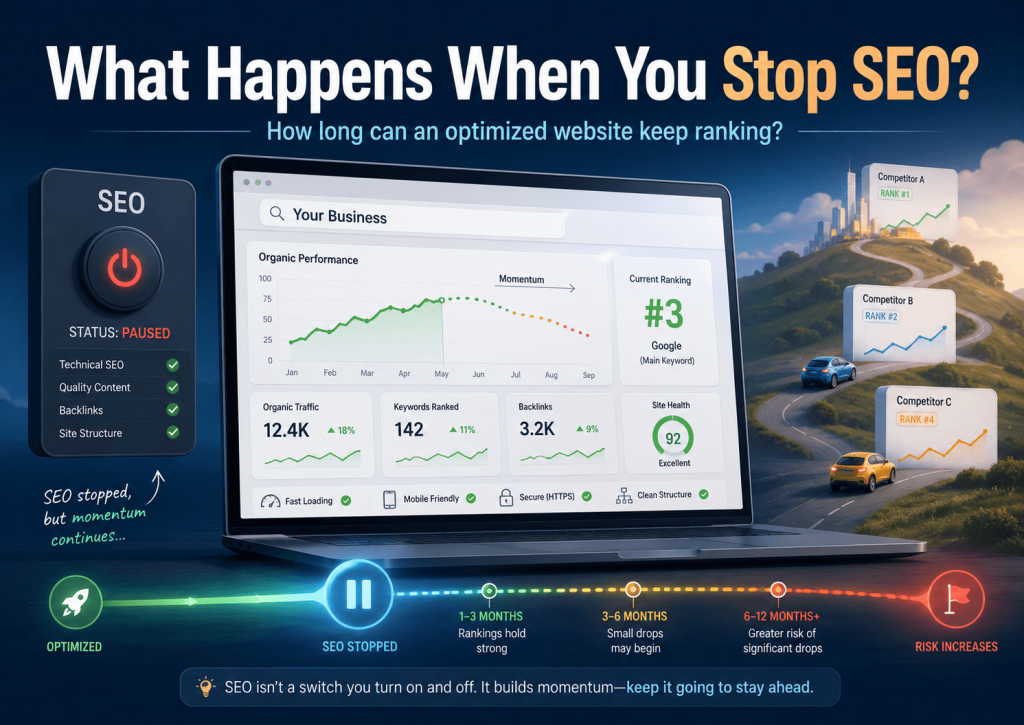
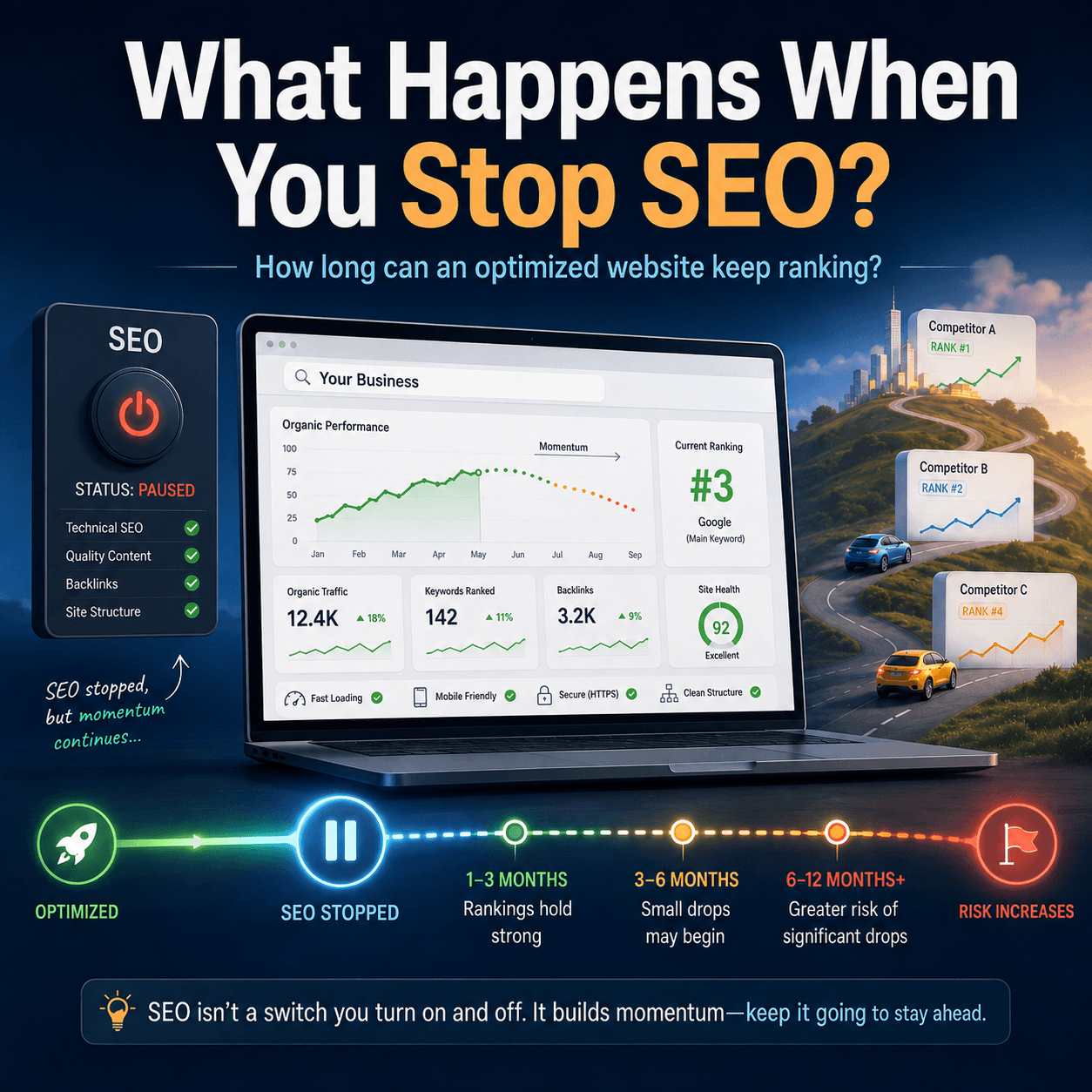
SEO work often produces lasting value. When activity stops, the website continues benefiting from the structure, content, authority, and technical improvements that were already created. It is living on accumulated momentum.
That momentum can be strong, but it is not the same as permanent protection.
A Realistic Timeline After SEO Work Stops
Every website is different, but the following timeline provides a practical way to understand the possible progression.
The First Few Weeks
During the first several weeks, rankings and traffic may remain almost unchanged.
The website still has:
- optimized pages;
- existing search visibility;
- established links;
- indexed content;
- historical performance;
- technical improvements completed during the SEO process.
Minor daily or weekly fluctuations are normal and do not necessarily mean that stopping SEO has already caused a problem.
At this stage, the main thing that has stopped is not necessarily performance. It is forward momentum.
One to Three Months
After one to three months, many websites may still appear stable.
However, early warning signs can begin to develop:
- competitors publish new or stronger content;
- some search queries change;
- important pages slowly lose impressions;
- new technical warnings appear;
- old offers or business details remain online;
- opportunities visible in Search Console are missed;
- competitors improve titles, pages, local profiles, or internal linking.
The business may not notice these changes if nobody is reviewing the data.
This is an important distinction: a website can look unchanged while its position relative to the market is already weakening.
Three to Six Months
Between three and six months, the difference between a maintained website and an untouched website can become more noticeable, especially in competitive industries.
Some pages may continue performing well, while others start losing positions.
The decline is not always dramatic. It may appear as:
- a page moving from position three to position five;
- fewer impressions for an important service;
- lower click-through rates;
- competitors replacing the website for longer and more specific searches;
- fewer appearances in local or visibility in AI-assisted search experiences;
- traffic becoming more dependent on a small number of older pages.
Small losses can accumulate before they become obvious in total traffic.
Six to Twelve Months
After six to twelve months without SEO monitoring or website maintenance, noticeable decline becomes more likely.
By this point:
- competitors may have added new pages;
- customer questions may have changed;
- previously accurate content may be incomplete;
- links may have broken;
- plugins, integrations or templates may have created technical problems;
- search-result layouts may have changed;
- important backlinks may have disappeared;
- the business may have introduced services that the website does not explain;
- search engines may have reassessed competing content.
A strong website may still rank well for established pages, particularly if the content remains the best available answer. However, overall growth has probably stopped, and the site may be losing opportunities it cannot see without monitoring.
Beyond One Year
Some pages can continue ranking for years with minimal intervention.
That is most likely when the content is:
- genuinely useful;
- accurate;
- difficult for competitors to improve upon;
- supported by strong links or brand recognition;
- technically accessible;
- focused on an evergreen subject.
But an entire business website is unlikely to remain equally competitive forever without attention.
Products change. Services evolve. Staff, locations, prices and policies change. Competitors invest in their websites. New search formats appear. Customer expectations move forward.
The website may not collapse, but it can gradually become a preserved version of the business rather than an accurate representation of the business today.
Why Rankings Can Continue After SEO Stops
SEO creates assets that can keep producing value.
These assets may include:
- helpful articles;
- well-structured service pages;
- descriptive page titles;
- internal links;
- external backlinks;
- local business signals;
- structured data;
- fast and accessible templates;
- clear navigation;
- indexed pages;
- historical authority;
- positive user experiences.
Unlike paid advertising, organic visibility does not necessarily disappear the moment monthly activity stops.
When an advertising campaign is paused, paid traffic usually stops quickly. When SEO work stops, the website can continue receiving organic traffic from work completed months or years earlier.
This long-term value is one of SEO’s greatest strengths.
However, it can also create a false sense of security. Because the decline is often delayed, a business may not notice that competitors are catching up until recovery requires considerably more work.
Why Rankings Eventually Become Vulnerable
A website does not compete only against its previous version.
It competes against everything else available to the searcher today.
Even if the website remains exactly as good as it was, the search environment around it keeps changing.
Competitors Continue Improving
A competitor may publish a more complete guide, improve a service page, earn stronger links, add useful photos, answer more customer questions, or provide a better mobile experience.
Your website does not need to become worse to lose a ranking.
Another website only needs to become more useful.
Information Becomes Outdated
Outdated information can reduce trust and usefulness.
Examples include:
- expired offers;
- old prices;
- incorrect opening hours;
- discontinued services;
- former staff members;
- obsolete screenshots;
- outdated software instructions;
- policies that have changed;
- statistics with no current context.
Not every article requires frequent updates, but pages containing changing information should be reviewed.
Search Intent Changes
People may begin describing the same need differently.
New terms can appear. Older phrases can become less common. Customers may expect comparisons, prices, examples, videos, FAQs, local details, or direct answers that were not previously necessary.
A page optimized for yesterday’s search behaviour may remain technically correct while becoming less aligned with what people now want.
Technical Problems Accumulate
Websites are not static documents.
Themes, plugins, apps, hosting environments, scripts, forms, analytics tools, and third-party integrations change over time.
Without monitoring, a website may develop:
- broken links;
- redirect problems;
- missing pages;
- indexing issues;
- slow-loading elements;
- mobile layout errors;
- form failures;
- duplicate pages;
- tracking problems;
- security vulnerabilities;
- expired integrations.
A single minor issue may not affect rankings, but several unresolved issues can gradually weaken performance and user trust.
Backlinks Can Be Lost
Backlinks are not always permanent.
A website linking to your business may close, remove an old article, restructure its pages, or replace the link. Meanwhile, competitors may continue earning new mentions.
If nobody monitors the site, the business may never realize that some of its external authority has disappeared.
Search Systems Continue Changing
Search rankings are dynamic.
Search engines regularly reassess pages and introduce changes to how they understand quality, relevance, helpfulness, location, products, images, video, and other types of information.
The evolution of SEO has always involved adapting to new search formats. Search is also expanding beyond traditional lists of blue links. AI-generated summaries, conversational search tools, local results, shopping features, maps, videos, forums and other formats can influence how customers discover businesses.
A website that was optimized for an earlier search environment may still perform, but maintaining visibility increasingly requires clear, trustworthy, structured and current information.
Not Every Website Needs Constant New Content
Stopping SEO should not be confused with deciding not to publish unnecessary content.
A business does not need to add a blog article every week simply because a marketing calendar says so. It does not need to rewrite a successful page every month. It should not change titles, headings or copy without a clear reason.
Unnecessary changes can even damage a page that is already performing well.
Good SEO maintenance is selective.
It means reviewing the evidence and asking:
- Is the page still accurate?
- Is it still helping the intended audience?
- Has its search performance changed?
- Are competitors now providing something more useful?
- Is there a technical problem?
- Has the business changed?
- Are visitors finding what they need?
- Is an update genuinely necessary?
Sometimes the correct decision is to improve the page.
Sometimes the correct decision is to leave it alone.
Stopping Growth Is Different From Losing Rankings
This is one of the most important distinctions.
When SEO work stops, the first effect may not be an immediate loss of traffic. The first effect may simply be that growth stops.
The website no longer:
- targets new customer questions;
- develops new service or location pages;
- improves weak pages;
- responds to emerging search demand;
- strengthens internal links;
- earns new authority;
- expands visibility in AI-assisted search;
- corrects issues found in performance data;
- adapts to changes in the business.
Traffic may look stable, but the website is missing opportunities it might otherwise have captured.
A flat line is not always proof that nothing is wrong. It can also represent growth that never happened.
SEO Maintenance Versus Full SEO Campaigns
Ongoing SEO does not always require a large campaign.
Once a website has a strong foundation, it may move into a lighter maintenance phase.
A practical maintenance plan could include:
- reviewing Google Search Console;
- checking organic traffic and conversions;
- monitoring important pages and queries;
- correcting indexing and technical errors;
- testing forms and key user journeys;
- updating information when it becomes inaccurate;
- refreshing pages that show meaningful decline;
- checking broken links and redirects;
- reviewing competitors periodically;
- adding new content only when there is a useful topic or business need;
- keeping local business information consistent;
- checking how clearly the website explains the business to both search engines and AI tools. For owners who want a practical starting point, the DIY SEO guide for small businesses can help them review their website’s SEO foundation.
The correct frequency depends on the website.
A highly competitive online store may require frequent attention. A small informational website in a stable niche may need only periodic reviews and targeted improvements.
The objective is not constant activity. It is appropriate attention.
What About a Website That Is Completely Abandoned?
Stopping active SEO and abandoning a website are not the same thing.
A business can pause content production while still maintaining its website, monitoring performance, installing safe updates, testing forms, and correcting important issues.
A completely abandoned website receives none of that protection.
Over time, abandonment can affect more than rankings. It can affect:
- security;
- functionality;
- credibility;
- accessibility;
- compatibility;
- customer enquiries;
- analytics accuracy;
- legal or policy information;
- the business’s public reputation.
Visitors may encounter broken pages, outdated information, unresponsive forms, or security warnings before search rankings show a major decline. Understanding ongoing website support and one-time fixes can help a business decide what kind of help is actually needed.
For many small businesses, the website is still an active business asset even during months when no new content is published.
Can Rankings Recover After SEO Restarts?
In many cases, yes.
A decline does not automatically mean that the website must be rebuilt or that all previous SEO value has disappeared.
Recovery may involve:
- identifying when and where the decline began;
- separating ranking losses from tracking problems or seasonal changes;
- reviewing the pages and search queries most affected;
- checking indexing, crawling, redirects, performance and mobile usability;
- comparing the content with current search intent and competitors;
- correcting outdated or incomplete information;
- improving internal links and page structure;
- restoring lost or broken pages;
- publishing new content only where a real gap exists;
- measuring the results over time.
Recovery is usually easier when the problem is identified early.
If a website remains untouched for years, the business may face a combination of content, technical, authority, design and tracking problems. At that stage, restoring performance can require much more than restarting a monthly blog.
How Can a Business Protect Existing SEO Results?
A small business that wants to reduce SEO activity without abandoning its progress should preserve a minimum level of oversight.
At minimum:
- keep the website secure and technically maintained;
- retain access to Google Search Console and analytics;
- review important performance trends periodically;
- make sure forms, calls, purchases and other conversions still work;
- update business information when it changes;
- watch for indexing warnings and major traffic drops;
- preserve successful URLs during redesigns or migrations;
- avoid deleting high-performing content without checking its value;
- refresh content when it becomes inaccurate or clearly weaker than competing results;
- maintain backups and a recovery plan.
This approach protects the work already completed without creating changes for the sake of activity.
So, How Long Will an Optimized Website Keep Ranking?
The most honest answer is:
It depends.
A strong evergreen page in a low-competition niche may rank for years with little change.
A commercial page in a competitive market may begin losing ground within a few months.
A seasonal, local, technical, product-based, or rapidly changing page may require more frequent review.
The quality of the original SEO work matters, but so do the actions of competitors and the changing needs of searchers.
SEO results can last. SEO positions cannot be guaranteed permanently.
Final Thoughts
Stopping SEO does not normally switch off organic traffic overnight.
A well-optimized website can continue benefiting from its content, structure, authority, and technical foundation for a long time. That lasting value is one reason SEO can be such a useful investment.
But the website does not exist in a frozen search environment.
Competitors improve. Information ages. Technology changes. Customer expectations evolve. Search platforms reassess what deserves visibility.
The best approach is not to make endless changes or publish content simply to appear active.
It is to monitor the website, protect what is already working, and make thoughtful improvements when the evidence shows that they are needed.
SEO maintenance is not about keeping a website constantly busy.
It is about preventing a valuable business asset from quietly falling behind. If you need a clearer picture of what is worth maintaining, 24WEB provides SEO audits and website maintenance for small-business websites.
Frequently Asked Questions
Do rankings disappear immediately when SEO stops?
Usually not. A well-optimized website may continue ranking because its pages, backlinks, authority, technical structure and search history remain in place. However, performance can gradually change as competitors improve, information becomes outdated, and technical or search-related conditions evolve.
How long can SEO results last without ongoing work?
There is no fixed duration. Some evergreen pages may perform for years with minimal changes, while competitive, local, seasonal, commercial or rapidly changing pages may begin losing visibility within months. The result depends on the page, industry, competition, content quality and technical condition.
Does a website need new blog posts every month to keep ranking?
No. Publishing content on a fixed schedule does not automatically improve rankings. New content should address a genuine customer question, search opportunity, business update or information gap. Existing pages should be changed only when an update would make them more accurate, useful or competitive.
What is the minimum SEO maintenance a small business should do?
At minimum, the business should maintain website security and functionality, retain access to Google Search Console and analytics, monitor major traffic changes, test important forms or purchasing paths, correct indexing problems, and update inaccurate business information.