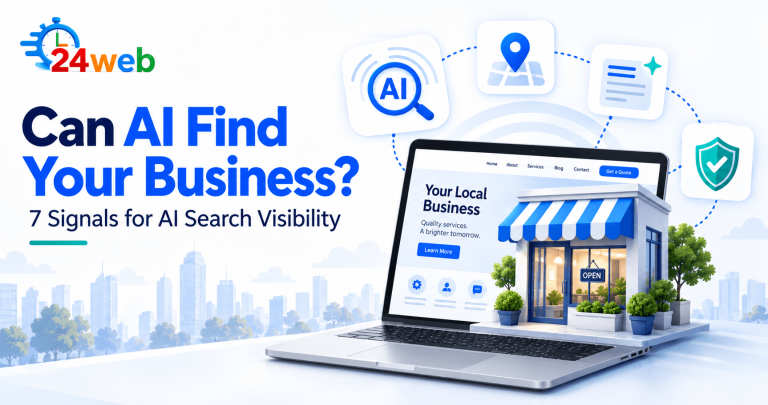
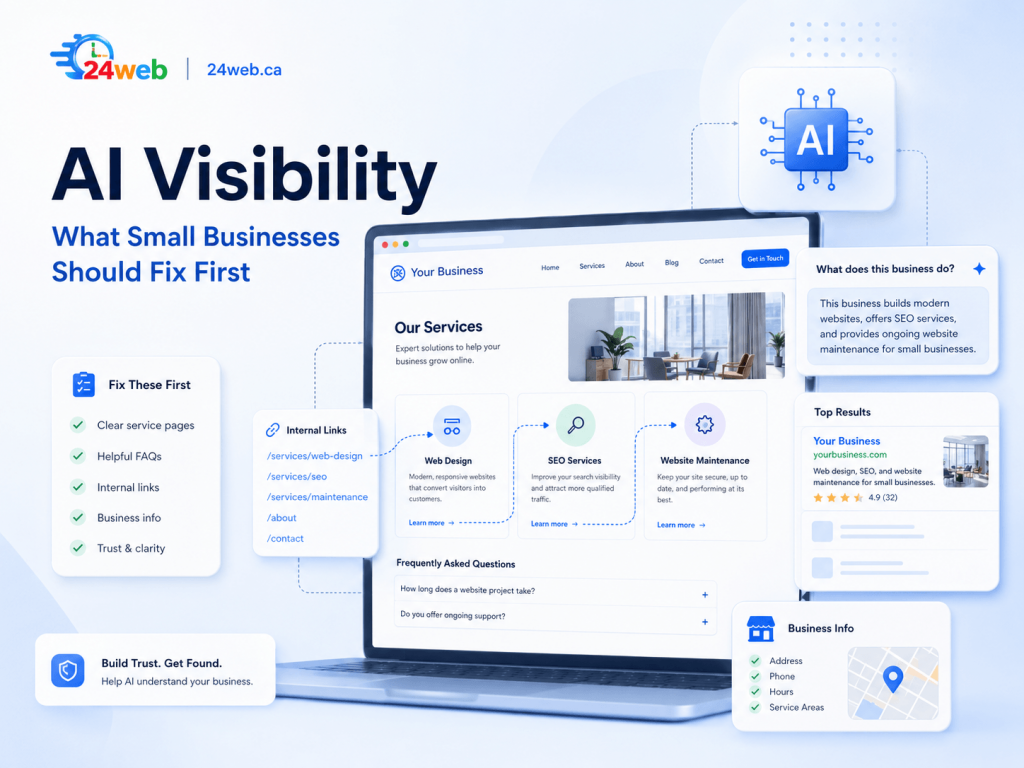
AI visibility is becoming an important part of modern SEO. Small businesses are no longer only thinking about blue links in Google. They also need to think about how AI Overviews, answer engines, chat assistants, and AI-powered search tools understand their services.
The good news is that AI visibility does not mean you need to rebuild your entire website or chase every new trend. For most small businesses, the practical starting point is simple: make your website clearer, more helpful, and easier for both people and search systems to understand.
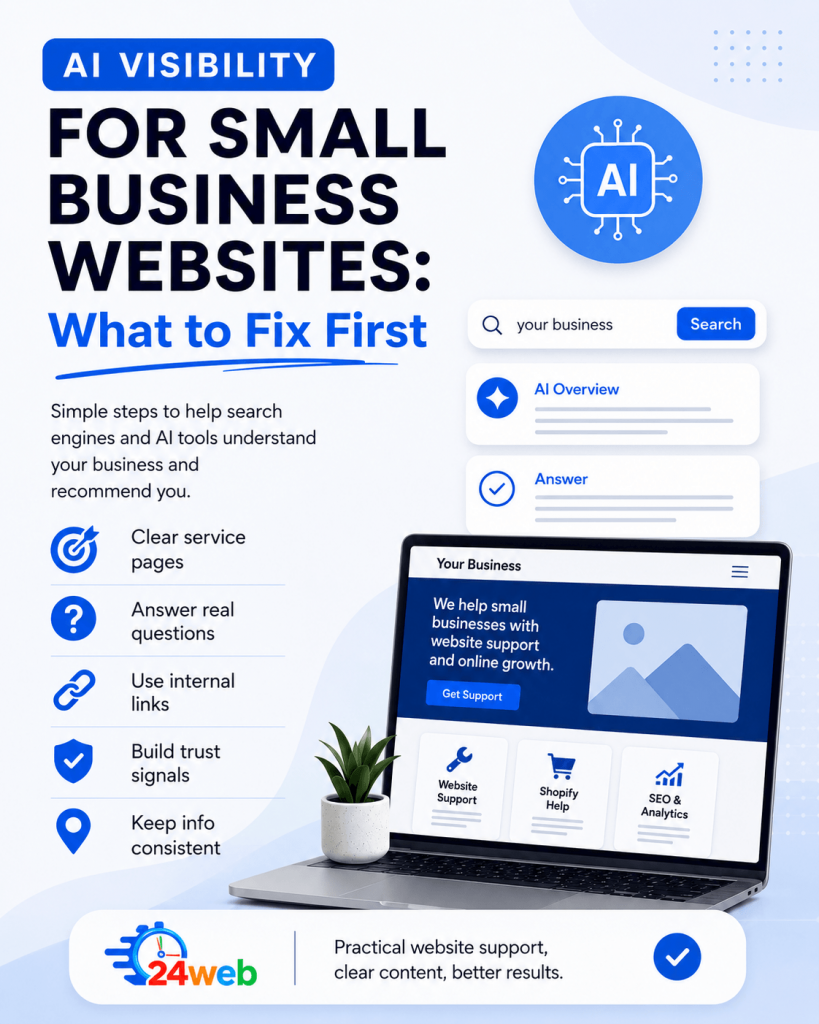
What AI visibility means
AI visibility means your business information is clear enough for search engines and AI-powered tools to understand, summarize, and reference. This includes what your business does, who you help, where you work, what problems you solve, and why someone should trust you.
A useful way to think about AI visibility is this: your website should make it easy for search engines and AI systems to answer basic questions about your business.
What do you do? Who do you help? Where are you based? What services do you offer? What makes your work trustworthy? If these answers are scattered, vague, or missing, AI tools may understand your competitors better than they understand you.
This is especially important for small businesses because AI search often summarizes options quickly. If your website does not explain your services clearly, you may be skipped even if your business is legitimate and experienced.
Traditional SEO is still important. You still need good page titles, useful content, technical health, internal links, and a website that loads properly. AI visibility adds another layer: your content needs to be easy to interpret, not just easy to crawl.
Start with your service pages
Your service pages are usually the most important pages for AI visibility. They explain what your business actually offers. If these pages are vague, too short, or written only for design instead of clarity, AI systems may not fully understand your services.
A strong service page should answer a few simple questions:
- What service do you provide?
- Who is this service for?
- What problems does it solve?
- What is included?
- Where do you provide this service?
- How can someone contact you or request help?
For example, a page that simply says “Website Support” is not as useful as a page that explains website updates, WordPress fixes, Shopify support, plugin troubleshooting, backups, security checks, speed improvements, and content edits.
The more clearly your page explains the service, the easier it becomes for both visitors and AI-powered search tools to understand when your business is relevant.
What to check on each important service page
Before thinking about advanced AI optimization, review your main service pages like a first-time visitor would. Each page should answer a few simple questions:
- What service is being offered?
- Who is this service for?
- What problem does it solve?
- What does the process look like?
- What should the visitor do next?
For example, a page about website maintenance should not only say “website updates.” It should explain what kind of updates are included, whether support is ongoing or one-time, what platforms are supported, and what kind of problems can be fixed.
Clear service pages help people make decisions. They also give search engines and AI systems stronger context about your business.
Use descriptive headings
Headings help structure your content. They also help search engines and AI tools understand the main topics on a page.
Instead of using vague headings like “Our Process” or “Solutions,” use headings that explain the topic more clearly. For example:
- Website Maintenance for Small Businesses
- WordPress Support and Monthly Updates
- Shopify Website Fixes and Product Page Help
- Google Ads and Basic Tracking Setup
- Local SEO Support for Service Businesses
Clear headings are not only good for SEO. They also make the page easier for visitors to scan quickly.
Answer common questions directly
AI-powered search often relies on clear, direct answers. This is why question-based content can be helpful. You do not need to overcomplicate it. Start by answering the real questions your customers already ask.
For example, a small business website could include answers to questions such as:
- How much does website maintenance cost?
- Do I need monthly website support?
- Can you fix a broken contact form?
- Can you help with Shopify updates?
- How often should WordPress plugins be updated?
- Do I need SEO if I already have a website?
These types of answers help visitors make decisions. They also give search engines and AI systems more context about your services.
Make your business easier to identify
AI search depends heavily on context. Your website should consistently describe your business, services, location, and audience.
For a small business, this can include:
- A clear business name
- Service categories written in plain language
- Location or service area
- Remote-friendly availability, if relevant
- Examples of problems you solve
- Links between related services and articles
This does not mean repeating the same keywords everywhere. It means making your website easier to understand as a real business with clear expertise.
For example, if your business offers website support in Canada and also works remotely with small businesses, say that clearly. If you support WordPress, Shopify, Google Ads, or website troubleshooting, make those services easy to find and understand.
Use FAQ content carefully
FAQ sections can be useful when they answer real questions. They should not be added only to fill space or repeat the same keywords. A good FAQ section should be practical, specific, and easy to understand.
For example, instead of writing:
Do you offer website services?
Yes, we offer website services.
A better answer would be:
Do you offer website support for small businesses?
Yes. We help small businesses with WordPress updates, Shopify edits, broken forms, content changes, website troubleshooting, backups, security checks, and basic SEO improvements.
This second version gives much more useful context. It explains the service clearly and naturally.
You can also use Google’s structured data documentation as a helpful reference when planning clearer machine-readable content, but the first priority should always be useful content for real visitors.
Add examples of real problems you solve
Small businesses often describe their services too generally. AI visibility improves when your content includes practical examples.
For example, instead of only saying “we provide website support,” you can explain that you help when:
- A contact form stops working
- A website becomes slow after plugin updates
- A Shopify product page needs better content
- A WordPress page layout breaks after an update
- A business needs a new banner, page section, or seasonal update
- Google Analytics or Search Console is not set up properly
Examples make your content more useful and more specific. They also help AI tools connect your business with the right type of search intent.
Internal links help AI and humans
Internal links show relationships between pages on your website. They help visitors move through your content, and they help search systems understand which pages are connected.
For example, a website maintenance page can link to an SEO audit page, a blog article about broken contact forms, a Shopify support page, and a contact form. These links create a clearer structure.
Internal links should feel natural. You do not need to force them into every sentence. The goal is to guide visitors toward the next useful page.
You can see this idea in my AI Search Checklist for Small Businesses, the Services page, and the Express SEO Test.
Keep your business information consistent
AI visibility is not only about blog articles. Your basic business information also matters. Your website, Google Business Profile, social media pages, and directory listings should use consistent information.
Check that your business name, services, service area, website URL, phone number, email address, and opening hours are accurate everywhere. Inconsistent information can make it harder for search engines and AI tools to trust your business details.
This is especially important for local businesses. If your website says one thing and your Google Business Profile says another, it can create confusion.
What not to do
Do not rewrite your entire website just to chase AI search. That usually creates thin, generic content that sounds like every other website.
Avoid publishing pages that only repeat phrases like “AI visibility,” “GEO,” or “AEO” without explaining anything useful. AI search is not about stuffing new buzzwords into old pages. It is about making your business easier to understand, verify, and recommend.
Start with clarity. Improve your service pages, answer real customer questions, connect related content, and keep your information accurate.
A simple AI visibility check
Here is a practical starting point:
Search for your business name in Google, ChatGPT, Perplexity, and Gemini. Then search for the type of service you offer plus your location or audience.
Look for three things:
- Does your business appear at all?
- Is the description accurate?
- Are competitors mentioned more clearly than you?
If your business does not appear, or if AI tools describe it poorly, that is a sign your website may need clearer content, stronger structure, better internal links, or more trust signals.
A simple AI visibility checklist
Here is a practical checklist for small business websites:
- Make sure every important service has its own clear page.
- Use descriptive headings that explain the topic.
- Answer common customer questions directly.
- Add real examples of problems you solve.
- Include your location or service area where relevant.
- Link related pages together naturally.
- Keep your contact information consistent.
- Update old or thin content.
- Make sure your website loads properly on mobile.
- Keep your website technically healthy with updates, backups, and security checks.
Final takeaway
AI visibility starts with clarity. A small business website should explain what the business does, who it helps, what services are available, and why the information can be trusted.
Good SEO still matters, but AI search adds a new layer. Your website needs to be understandable enough for people, search engines, and AI systems to connect the dots.
The best first step is not a complicated AI strategy. It is a clearer, better-structured website.