You have updated your website, improved a few pages and started working on SEO. Now comes the obvious question: when will it start bringing in more customers?
The honest answer is that early changes can appear within weeks, but meaningful organic growth should be planned and evaluated over months, not days. Some websites move sooner. Others need a longer period of improvement, and some changes do not produce a noticeable search benefit at all.
That does not mean paying for SEO indefinitely and hoping something happens. It means understanding what work is being done, what progress looks like, and when to change the plan.
1. What Does “SEO Results” Actually Mean?
Before setting a timeline, define the result you want. These are different milestones:
- Discovery and indexing: an important page becomes available in Google’s search index.
- Visibility: the page appears for relevant searches.
- Traffic: people click through to the website.
- Business outcomes: those visitors submit qualified inquiries, book appointments or place orders.
A page being indexed does not mean it ranks well. More impressions do not automatically produce more clicks. More visitors do not guarantee more sales.
For a small business, the goal should be useful visibility that contributes to real business outcomes—not just a larger number in a report.
2. How Long Does SEO Take? A Practical Planning Timeline
Google’s SEO Starter Guide explains that changes can take from a few hours to several months to be reflected in Search. It also recommends allowing a few weeks before assessing their effects and notes that not every change produces a noticeable impact.
The timeline below is a suggested work and review schedule, not a Google benchmark or a promise of results. It assumes meaningful changes are actually being implemented. Time spent waiting for approvals is not the same as time with improved pages live.
| Period | Main focus | What to evaluate |
|---|---|---|
| Weeks 1–4 | Establish a baseline, check tracking and resolve priority blockers. | Which fixes are live? Can important pages be indexed? Do forms and checkout work? |
| Months 2–3 | Improve priority pages, clarify content and strengthen relevant internal links. | Are the updated pages reaching relevant searches? Are early click or inquiry changes meaningful? |
| Months 4–6 | Review patterns, refine weak pages and expand work supported by evidence. | Is relevant organic traffic improving? Is it contributing to qualified leads or sales? |
| Months 6–12 and beyond | Reassess commercial value and maintain or adjust the strategy. | Are results worth the effort and cost? What should continue, change or stop? |
You do not need to wait six months to investigate a broken form or a page accidentally excluded from indexing. Equally, one quiet week after publishing is not a good reason to rewrite everything.
3. Why Two Websites Can Have Very Different Timelines
The starting point
An established website with relevant traffic gives you existing pages and search data to work with. A new website has less evidence to guide decisions and may still need essential service content, discovery and recognition. An older domain alone is not a shortcut.
The competition and search intent
Competing for a specific local service is a different project from competing nationally for a broad product category. The right page must also match what the searcher needs: advice, a service provider, a product or a nearby location.
The quality of the website
Incomplete service descriptions, confusing navigation and missing buying information can require substantial work. A polished design cannot compensate for a page that does not answer the customer’s question.
The pace of implementation
An audit sitting in an inbox changes nothing. Access, approvals, product information and technical support all affect how quickly recommendations become real improvements.
4. Does Working More Hours Produce Faster Results?
More time can help you complete more useful work. It cannot make Google follow your schedule, create demand that does not exist or turn irrelevant content into something customers want.
For a small website, a focused monthly plan might include reviewing performance, improving one priority page, addressing a technical issue and testing the contact journey. A larger store may need separate work across collections, products, navigation and tracking.
Measure the value of the work, not just the hours logged. Ask what was improved, why it mattered and how the outcome will be assessed.
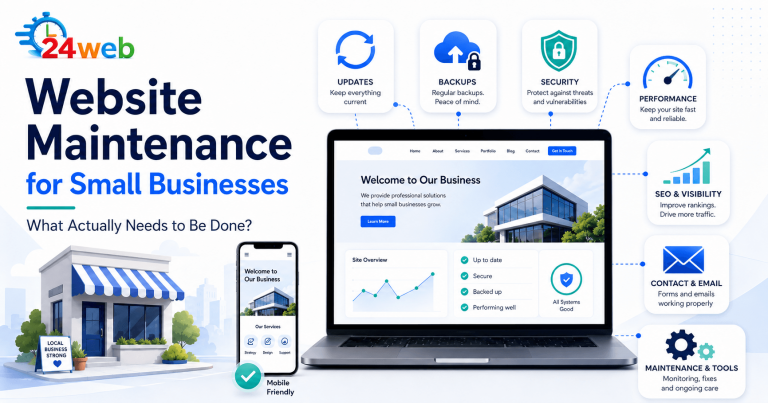
Also distinguish maintenance from growth work. Backups and safe updates protect the website; improving service content and search relevance addresses different needs. Our guide to website maintenance for small businesses explains the ongoing care side.
5. What Should You Check First?
Before commissioning more articles or a full redesign, check the basics:
- Priority pages: do you have clear pages for the services or products you want to sell?
- Indexability: are important pages accessible to search engines and free of accidental indexing restrictions?
- Customer information: can visitors understand what you offer, where you operate and how to buy or contact you?
- Mobile usability: can someone read the page and complete the next step comfortably on a phone?
- Forms and checkout: do real test submissions and transactions work?
- Measurement: are Search Console and analytics collecting useful data, with meaningful conversion events configured?
- Baseline: have you recorded current performance and the dates of major changes?
A working contact form may help existing visitors immediately. That is valuable, but it is a conversion improvement—not proof that search rankings increased.
6. How to Recognize Progress Without Fooling Yourself
Start with Google Search Console to review the pages and searches bringing visibility and clicks. Then use analytics and actual inquiries or orders to understand what happens after people arrive.
A simple monthly review should answer:
- Which important pages were improved, and when?
- Are they appearing for searches relevant to our business?
- Are clicks reaching pages that can generate inquiries or sales?
- Are qualified leads or purchases changing?
- What will we test or improve next?
Compare equivalent periods and consider seasonality. A gift business approaching a holiday can grow because demand is rising; that does not prove every increase came from SEO. Separate searches for your business name from searches by people who may not know you yet where the data allows.
Do not judge the whole project by average position alone. If a website starts appearing for additional searches at lower positions, its overall average can worsen even while visibility expands. Check the relevant pages and queries behind the number.
Small volumes also need perspective. Two inquiries instead of one is a 100% increase, but not yet strong evidence of a sustained trend.
7. When Should You Change the SEO Plan?
Patience is reasonable when useful work is live, measurement is reliable and the review explains what is happening. “SEO takes time” should not be the only explanation you receive.
Investigate sooner if:
- Reports list activity but cannot identify completed improvements.
- The same technical blockers remain unresolved.
- Content attracts people outside your market or service area.
- Traffic rises but the inquiries are irrelevant.
- Conversion tracking is missing or unreliable.
- The strategy never changes despite repeated evidence that it is not helping.
At an agreed checkpoint, such as three months after substantial work begins, review the evidence together. You might need better targeting, stronger pages, a simpler contact process or a narrower scope—not automatically more blog posts.
If the website generates leads but they do not become customers, investigate pricing, fit, availability and follow-up too. SEO is only one part of the customer journey.
8. Does SEO Become “Finished” Once It Works?
Reaching a useful level of organic traffic does not mean every page needs constant editing. It does mean you should keep checking whether the website remains accurate, functional and commercially useful.
The workload can change from fixing major weaknesses to maintaining strong pages and addressing new opportunities. For the other side of this discussion, read what happens when you stop SEO.
If you are also reviewing AI search visibility, our AI Search Checklist for Small Businesses provides a separate starting point. Treat AI visibility as another area to assess, not a shortcut to guaranteed organic growth.
Final Thoughts
SEO does not work on a fixed countdown. Plan for months of focused improvement, watch for early evidence, and make decisions using relevant traffic and business outcomes.
The better question is not simply “How long have we been doing SEO?” It is: “What has improved, what evidence do we have, and what should happen next?”
Consistency matters—but consistency means useful work and informed adjustments, not repeating the same tasks forever.
Frequently Asked Questions
Can SEO work in one month?
Some fixes can produce early changes within a month, particularly on an existing website. One month is not a reliable deadline for sustained organic traffic, qualified leads or sales.
Is three months enough to judge SEO?
Three months can be a useful review point if meaningful improvements have been live long enough to assess. Review completed work, relevant search visibility and conversions before deciding whether to continue or change direction.
How many hours of SEO does a small business need?
There is no universal minimum. The right workload depends on the website, competition and tasks involved. Agree on specific deliverables and separate maintenance time from active SEO improvement work.
Do I need to publish a blog post every week?
No. A useful service page, improved product collection or updated article may be a better priority than a weekly post. Publish when you have something relevant and helpful to add.
Will a website redesign improve rankings?
Not automatically. A redesign may improve usability, but rankings depend on more than appearance. Preserve useful content, working URLs or appropriate redirects, internal links and indexability.
Can someone guarantee when my website will rank first?
No. A provider can commit to agreed work and reporting, but cannot guarantee a particular organic ranking or the date it will be achieved.
Need Help Finding Your Website’s Next Priority?
At 24Web, I help small businesses with WordPress and Shopify support, practical SEO improvements, website updates and tracking checks. If you are unsure whether your website needs technical fixes, clearer content or a better way to measure results, start with a conversation about your priorities.