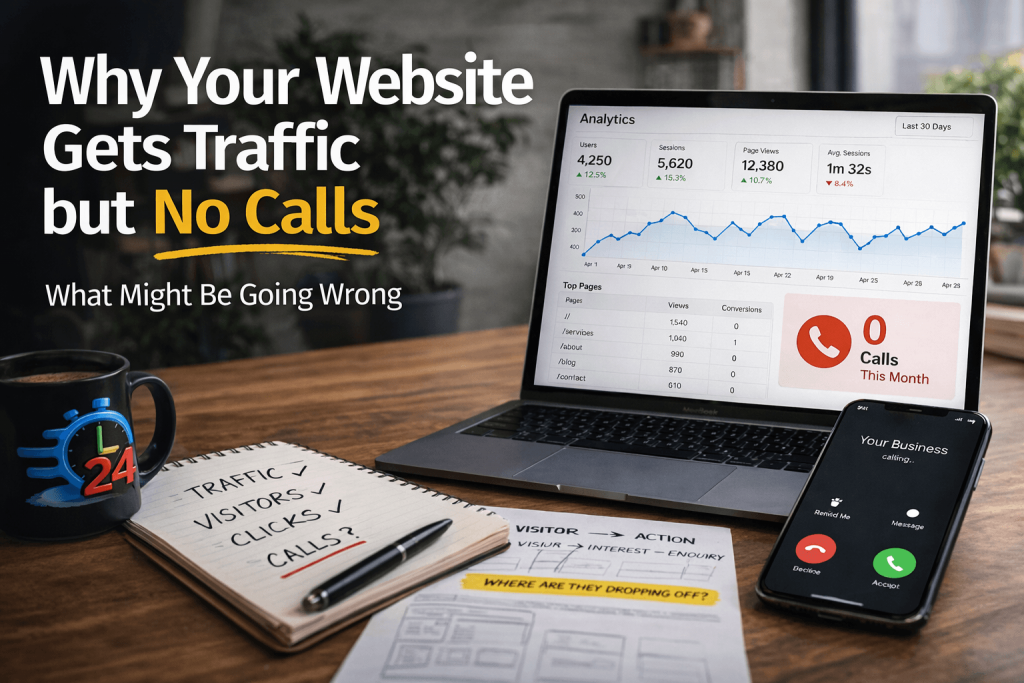
You’re getting visitors to your website, but the phone stays quiet.
No calls or form submissions, no quote requests.
This is one of the most frustrating problems for small business owners. You may be putting effort into SEO, social media, or even paid ads, yet the traffic does not turn into real enquiries.
In many cases, the issue is not the lack of visitors. The issue is that the website is not giving those visitors enough clarity, trust, or direction to take the next step.
Here are the most common reasons your website gets traffic but no calls.
1. You’re attracting the wrong traffic
Not all traffic is good traffic.
A website can get visits from people who are not actually looking to hire you, buy from you, or contact your business. This often happens when the content is too broad or targets keywords that bring in general readers instead of local buyers.
For a small business, traffic only matters when it comes from the right people in the right area with the right intent.
A busy-looking analytics report does not always mean the site is producing leads.
2. Your message is too vague
When someone lands on your homepage, they should understand almost immediately:
- what you do
- who you help
- where you work
- what they should do next
If your headline says something generic like “quality solutions” or “professional services,” visitors may not understand your offer quickly enough.
Clear beats clever.
A homepage that plainly explains the service, location, and next step usually converts better than one filled with vague marketing language.
3. Your call-to-action is weak or hard to find
Some websites never clearly ask the visitor to do anything.
If your phone number is hard to spot, your contact button blends into the page, or your form is buried too far down, people may leave without acting.
Your main call-to-action should be easy to find and easy to understand.
Examples include:
- Call now
- Request a quote
- Book a consultation
- Send a message
If the next step is unclear, many visitors will do nothing.
4. Your website does not build enough trust
People do not contact a business unless they feel reasonably confident first.
If a site looks outdated, broken, unfinished, or generic, trust drops fast. Even small issues can make a visitor hesitate.
Common trust problems include:
- outdated design
- missing reviews or testimonials
- no visible business details
- poor-quality photos
- broken images or links
- awkward or inconsistent wording
A visitor may like your service, but if the website feels neglected, they may move on to a competitor.
5. Your contact form may not be working properly
This happens more often than many business owners realize.
Sometimes forms look fine but submissions never arrive. In other cases, the form works, but it is too long, confusing, or frustrating on mobile.
A good contact form should be:
- short
- simple
- mobile-friendly
- connected to a working email address
- tested regularly
If you are not checking your forms, you could be losing leads without knowing it.
6. Your website is too slow
A slow website can quietly hurt conversions.

If pages take too long to load, some visitors will leave before they even see your offer. This is especially true on mobile devices.
Common causes of slow websites include:
- oversized images
- too many plugins
- poor hosting
- heavy page builders
- unoptimized scripts or fonts
Most people will not tell you the site is slow. They will just leave.
7. The mobile experience is poor
A large share of local business traffic now comes from phones.
If your website is hard to use on mobile, you are likely losing calls and enquiries. A visitor should be able to understand your offer and contact you quickly from a small screen.
Common mobile issues include:
- tiny buttons
- hard-to-read text
- broken layouts
- intrusive popups
- buried contact details
- difficult forms
If calling or messaging your business feels awkward on mobile, many people will not bother.
8. There are too many distractions on the page
Too many options can reduce action.
When a page has too many buttons, too many links, too much text, or too many competing sections, the visitor may feel overwhelmed.
A higher-converting page usually feels more focused. It guides people toward one clear next step instead of asking them to sort through everything themselves.
9. Your local signals are weak
If you serve a local area, your website should make that obvious.
Visitors should not have to guess whether you work in their city or region. Search engines also rely on local signals to understand your relevance.
Helpful local signals include:
- city and region in page copy
- service area mentions
- consistent contact details
- location information
- local service pages where appropriate
If your site is vague about location, both visitors and search engines may hesitate.
10. Your offer is not clear or compelling enough
Sometimes the website works, but the offer is weak.
If the visitor cannot quickly see why they should contact you instead of someone else, they may leave without taking action.
A stronger offer might highlight:
- fast response times
- free estimates
- same-day help
- clear turnaround
- straightforward process
- real examples of work
People need a reason to choose you now instead of later.
11. You are not showing enough proof
People want reassurance before they reach out.
That proof can include:
- Google reviews
- testimonials
- project examples
- before-and-after results
- client logos
- years in business
- photos of real work
Without proof, the visitor has to trust you too early. Most will not.
12. You’re measuring traffic, not conversions
Traffic alone is not the goal.
A page may get visitors who stay only a few seconds. A blog post may bring in readers who never look at your service pages. Some visitors may come from places you do not even serve.
What matters more is whether your website produces useful actions, such as:
- phone calls
- form submissions
- quote requests
- appointment bookings
- email enquiries
A website with less traffic but better conversion can outperform a site with more traffic and no leads.
What to check first
If your website gets traffic but no calls, start here:
- read your homepage like a first-time visitor
- make sure your phone number is easy to find
- test your contact form
- review the site on mobile
- check page speed
- clarify your service area
- strengthen your main call-to-action
- add trust signals and proof
You may not need a full redesign. Sometimes, a few targeted fixes can improve results quickly.
Final thoughts
A website that gets traffic but no calls is often not failing because nobody is interested. It is failing because the path from visitor to enquiry is too weak.
The site may be unclear, slow, unconvincing, or difficult to use.
The goal is not just to bring people in. The goal is to help the right visitors feel confident enough to contact you.
If your website gets visits but no leads, it may be time to review the parts that affect conversion most: messaging, calls-to-action, trust signals, forms, speed, and mobile experience.
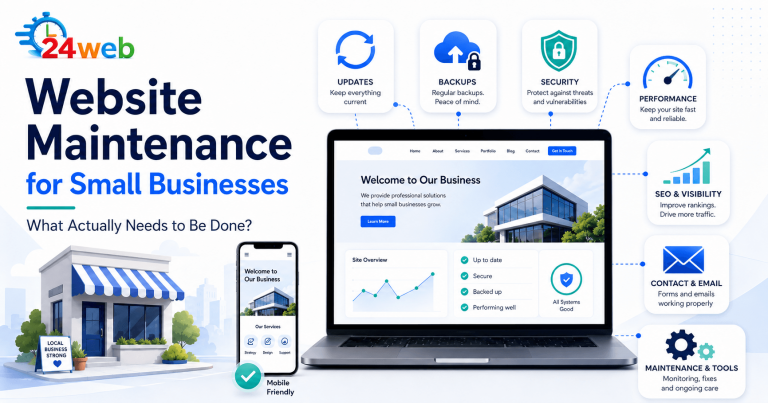
Small improvements in the right places can make a real difference. Contact 24WEB if you need web assistance or on-going support.
Usually because the site is attracting the wrong traffic, the message is unclear, the call-to-action is weak, or visitors do not trust the website enough to contact the business.
Yes. If a site loads too slowly, visitors often leave before they interact with the page, especially on mobile.
You should test it regularly by submitting a real message and confirming that it arrives correctly at your email address.
Not always. Many websites improve with clearer messaging, better calls-to-action, stronger trust signals, faster speed, and a better mobile layout.
It should clearly explain the service, show the location served, build trust, make contact details obvious, and give visitors an easy next step.