For years, search visibility mostly meant one thing: ranking well in Google.
If your website showed up near the top of search results, you had a better chance of getting clicks, traffic, and leads. That is still true today. But the search experience has changed. Users are now getting direct answers inside AI-powered search experiences instead of only scanning a page of links. Google has expanded AI Overviews and AI Mode, while ChatGPT search is now available across ChatGPT plans and can answer questions with web links built into the experience.
That is where the conversation around SEO vs GEO comes from.
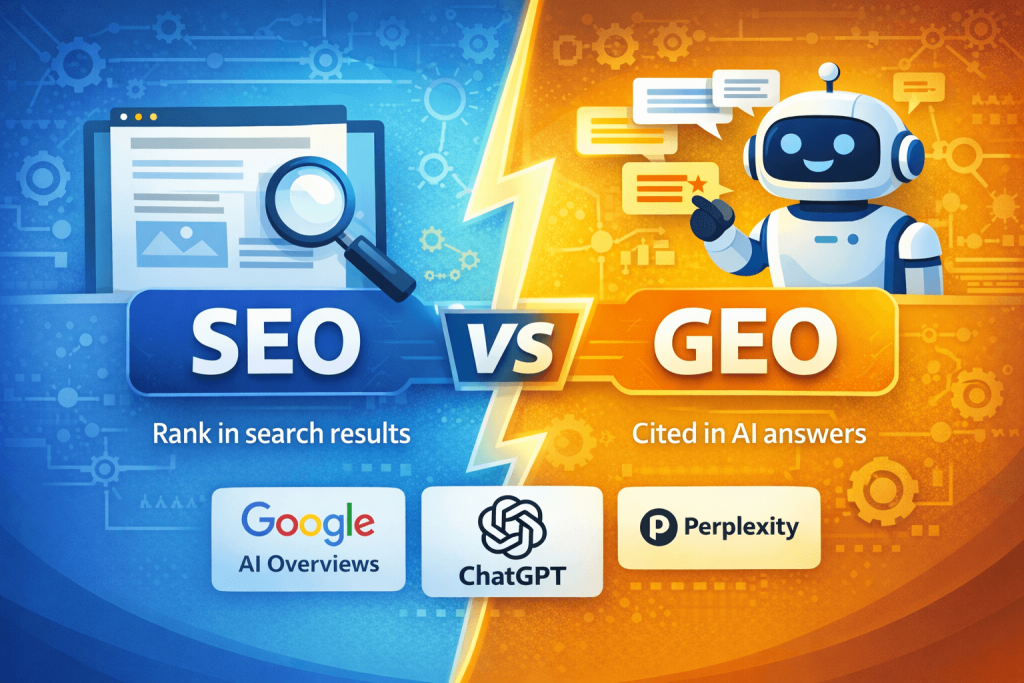
SEO is still about helping your pages rank in search engines. GEO, or Generative Engine Optimization, is about helping your business and content appear in AI-generated answers, summaries, and citations across tools like Google AI features, ChatGPT, and Perplexity. Current industry guidance increasingly frames GEO as optimizing for mention, citation, and recommendation inside generative search experiences, not just for a blue-link ranking.
What is SEO?
SEO stands for Search Engine Optimization.
Traditionally, SEO focuses on improving how your website performs in organic search results. That includes things like page quality, keyword targeting, technical health, internal linking, site structure, and earning authority over time. The goal is simple: help search engines understand your pages well enough to rank them for relevant searches. Google’s current guidance for AI-era search still points site owners back to the same core fundamentals of accessible, helpful, people-first content.
What is GEO?
GEO stands for Generative Engine Optimization.
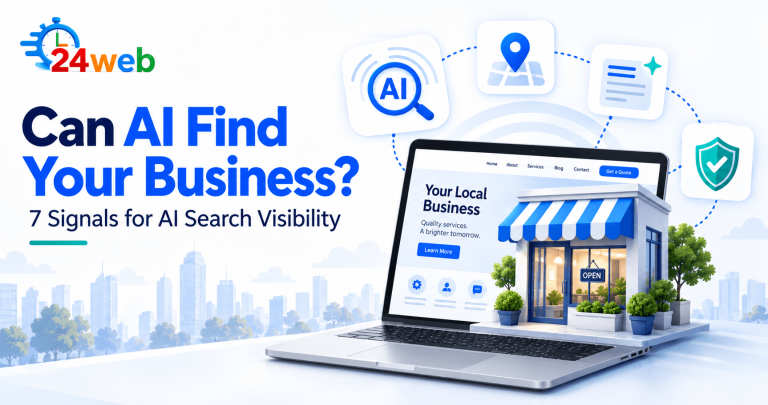
Unlike traditional SEO, GEO is not only about rankings. It is about helping AI systems understand your business well enough to use your content in answers. In practice, that means structuring your website so AI tools can interpret it clearly and summarize it accurately. It also improves the chances that your business may be mentioned or cited when users ask relevant questions. Search Engine Land describes GEO as positioning your brand and content so AI platforms can cite, recommend, or mention you in generated responses.
So what actually changed?
The biggest change is this:
Search is no longer just a list of links.
When someone asks a traditional search engine a question, they still often get a page of results. But increasingly, they may also get an AI-generated response that summarizes information before they click anything. Google says its AI features are designed to help users ask more complex questions and get synthesized answers, and ChatGPT search similarly provides timely answers with links to sources from the web.
That changes what visibility looks like.
Before, success often meant being one of the top results. Now, success may also mean being one of the sources an AI system chooses to reference, quote, or learn from when building an answer. That does not make SEO obsolete. It just means the path between “being visible” and “getting discovered” is broader than it used to be.
SEO and GEO are not enemies
One of the biggest mistakes in this discussion is treating SEO and GEO like they are competing strategies.
They are not.
In reality, strong GEO usually starts with strong SEO. If your site is hard to crawl, unclear, thin on useful content, or technically weak, you are making life harder for both search engines and AI systems. Google’s own documentation on AI features does not describe a separate loophole or shortcut for appearing in AI results. It points website owners back to the same practical foundation: create satisfying content, provide a good page experience, and make sure Google can access and understand what is on the page.
So the better way to think about it is this:
SEO helps you rank. GEO helps you get used in AI answers.
And in many cases, the same website improvements help with both.
Where SEO and GEO overlap
They overlap more than people think.
Both SEO and GEO benefit from a clear site structure, useful content, descriptive headings, strong internal links, page-level relevance, and a trustworthy brand presence. If your service pages clearly explain what you do, who you help, and where you work, that helps search engines rank you and helps AI systems understand you. Google’s AI guidance makes that connection pretty clear by anchoring AI visibility to familiar search quality best practices.
For example, a vague page that says, “We provide digital solutions for growing businesses,” does not help much in either world.
A page that says, “We provide WordPress maintenance, Shopify fixes, speed optimization, and technical SEO for small businesses in Montreal and across Canada,” is much easier for both search engines and AI tools to understand and use.
Where GEO pushes things further
GEO puts more pressure on clarity, structure, and answerability.
It is not enough for a page to vaguely target a keyword anymore. It should also be easy to summarize, easy to verify, and easy to map to a real question someone might ask inside an AI interface. That often means writing more directly, covering topics more completely, and structuring information so it can be interpreted without guesswork. Current GEO guidance emphasizes source-worthiness: content that is specific, useful, and clearly associated with a real brand or expert tends to be more reusable in AI-driven results.
This is especially important for small businesses, because many local or service-based sites still rely on thin pages, generic marketing language, and weak content depth. That was already limiting in classic SEO. In AI-driven discovery, it can be even more limiting because the system has less solid information to work with.
What this means for small business websites
For a small business, the shift from SEO-only thinking to SEO-plus-GEO thinking is actually very practical.
Your website should do more than try to rank for keywords. It should answer real questions clearly and explain your services in plain language. Strong trust signals also matter, including a real business identity, consistent branding, location details where relevant, and content that shows experience. These signals help your business look credible and understandable across both traditional and AI-powered discovery.
If someone asks, “Who can help fix a slow Shopify site?” or “Who offers website maintenance for a small business in Montreal?” the question is no longer only whether your page can rank. The question is also whether your site gives enough useful, structured, trustworthy information to be part of the answer.
What should businesses do now?
The answer is not to panic and rewrite your whole site around buzzwords.
The smarter move is to strengthen the basics and make your content more useful. Keep your technical SEO healthy. Improve thin service pages. Add FAQ content where it helps. Use headings that make sense. Write clearer descriptions of your services. Show who you help and where you work. Build supporting content around real customer questions. Those actions are consistent with Google’s official advice for AI features and with current industry GEO guidance.
In other words, the rise of GEO does not mean abandoning SEO. It means building on it.
Final thoughts
SEO still matters because search engines still need to understand, rank, and surface your pages.
GEO matters because more people now search in environments where AI summarizes the web before a click happens. As Google and ChatGPT continue expanding AI-powered search experiences, businesses need to think beyond rankings alone and pay more attention to whether their websites are clear enough to be cited, summarized, and trusted.
The real takeaway is not “SEO or GEO.”
It is this:
Your website now needs to work for search engines, AI systems, and real people at the same time.
And usually, the businesses that do that best are the ones with the clearest, most helpful websites.
24web helps small businesses improve their websites for both traditional SEO and AI-driven search.