For years, business owners were told to focus on SEO: rank higher in Google, get more clicks, and turn that traffic into leads.
That advice still matters. But search is changing.
Today, people are no longer relying only on traditional search results. They are also asking questions directly inside tools like Google’s AI search features, ChatGPT, and other answer engines. Instead of clicking through ten blue links, users often get an instant summary with a handful of recommended sources. Google has been steadily expanding AI Overviews, including in Canada, and says these AI features are now available in more than 200 countries and territories across more than 40 languages.
That shift is one reason GEO has become a hot topic.
What does GEO mean?
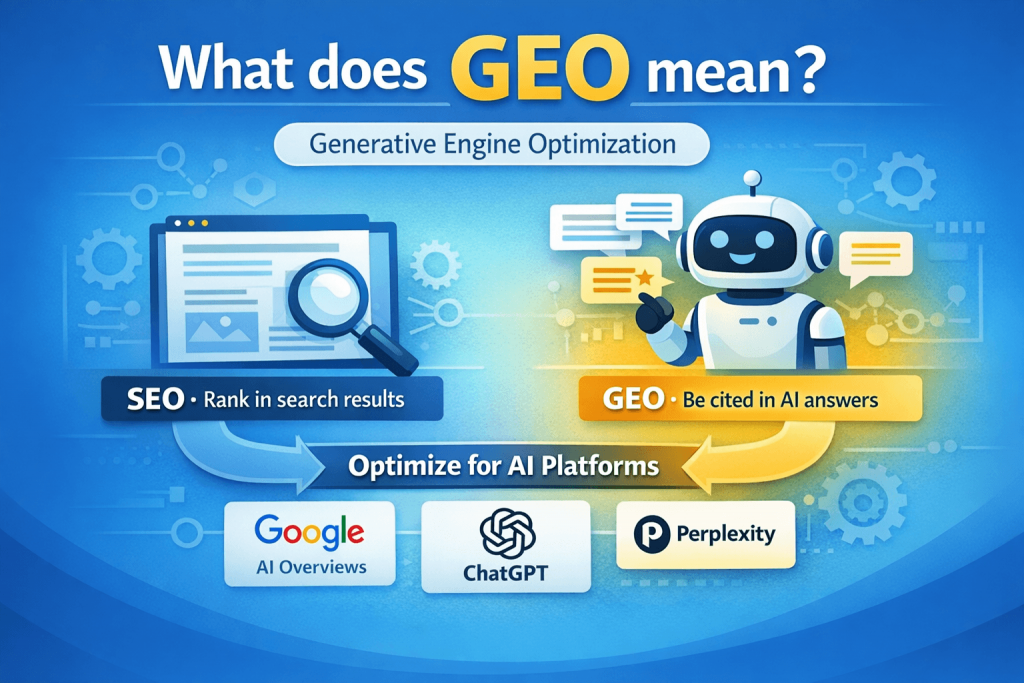
GEO stands for Generative Engine Optimization.
In simple terms, GEO is the practice of improving your website and online presence so AI-powered search tools can better understand your business, trust your content, and potentially mention or cite your pages in their answers. Current industry definitions describe GEO as optimizing content so platforms such as Google AI Overviews, ChatGPT, and Perplexity can cite, recommend, or mention a brand in generated responses.
You can think of it like this:
SEO helps your site rank in search results.
GEO helps your business become a useful source for AI-generated answers.
They are connected, but not exactly the same.
Why is GEO trending right now?
Because the way people search is changing fast.
Google’s AI search features have expanded quickly over the last two years. AI Overviews first rolled out broadly in the U.S. in 2024, expanded to Canada later that year, reached more than 100 countries by October 2024, and then expanded to more than 200 countries and territories by May 2025. Google has also continued adding newer AI-driven search experiences and follow-up capabilities.
That means more users are getting answers directly inside AI-enhanced search experiences instead of browsing websites the old-fashioned way.
For small businesses, that creates a new question:
Will your business be part of the answer, or left out of it?
That is exactly why GEO is trending. Businesses, marketers, and web professionals are realizing that visibility is no longer just about ranking on page one. It is also about being understandable, trustworthy, and quotable in AI-driven search environments. Google’s own guidance to site owners now includes a dedicated section on AI features and how websites can appear within them.
Is GEO replacing SEO?
No.
That is one of the biggest misconceptions right now.
GEO is not a replacement for SEO. In most cases, strong GEO starts with strong SEO fundamentals: clear site structure, crawlable pages, helpful content, strong titles, good internal linking, and a technically sound website. Google’s documentation for AI features points site owners back to creating helpful, people-first content and ensuring Google can access and understand the page.
So instead of thinking SEO vs GEO, it is better to think:
SEO gets you discovered. GEO helps you get selected, cited, or summarized by AI tools.
If your site is slow, confusing, thin on content, or unclear about what you do, you are weaker in both SEO and GEO.
How is GEO different from traditional SEO?
Traditional SEO often focuses on things like:
- keyword targeting
- rankings
- search intent
- metadata
- backlinks
- page quality
GEO still benefits from those things, but it also places more weight on whether your content is:
- easy for AI systems to interpret
- clearly written and well-structured
- directly aligned with real questions people ask
- trustworthy and specific
- supported by strong brand and entity signals
In plain English, AI systems tend to prefer content that is easy to summarize and easy to trust.
A vague service page that says, “We provide quality solutions for all your needs” is not very useful.
A clear page that says, “We provide WordPress maintenance, Shopify fixes, speed optimization, and technical SEO for small businesses in Montreal and across Canada” is much more useful.
That second version gives both humans and AI more to work with.
What do AI engines look for?
No one outside the platforms knows every signal. But current guidance and industry analysis point in a clear direction.
AI-powered discovery tends to work better with content that is:
- clear
- accurate
- well-organized
- specific
- authoritative
- genuinely helpful
Google specifically advises site owners to focus on unique, valuable content for people and to make sure their pages are accessible to Google. Its AI feature guidance does not suggest a separate trick or loophole for AI visibility. It points back to the same core principles behind high-quality search content.
For small businesses, that usually means:
- clear service pages
- strong about and contact information
- location details where relevant
- FAQ sections that answer real customer questions
- consistent branding across the web
- helpful articles that explain topics simply
- proof of experience, trust, and credibility
Why GEO matters for small businesses
A lot of small business websites still have thin service pages, outdated metadata, weak internal linking, and barely any helpful content.
That was already a problem for SEO.
Now it is also a problem for GEO.
If someone asks an AI tool:
- “Who offers website maintenance for small businesses in Montreal?”
- “What should I look for in a Shopify support provider?”
- “How do I improve my website without hiring a full-time developer?”
…the systems generating those answers will pull from sources they can understand and trust.
If your website clearly explains what you do, who you help, where you work, and how your service solves problems, you have a better chance of being part of that conversation.
If your site is vague or incomplete, AI tools have less reason to surface it.
Simple GEO tips for a small business website
You do not need to rebuild your whole website tomorrow. But you should start improving the basics.
1. Make your services extremely clear
Avoid generic wording. Say exactly what you do, who it is for, and where you work.
2. Answer real customer questions
FAQ sections, blog posts, and service content should reflect how people actually ask questions today.
3. Create helpful pages, not just promotional ones
AI systems tend to work better with content that explains, compares, and clarifies.
4. Strengthen your trust signals
Show your business name consistently, include contact details, explain your experience, and make your website feel real and credible.
5. Improve structure
Use strong headings, short paragraphs, logical page sections, and clean navigation.
6. Keep your technical SEO healthy
Make sure pages can be crawled, load properly, and are not buried behind weak architecture.
7. Build topic depth
One thin page is rarely enough. Supporting articles, FAQs, and related service pages help build context.
A practical example
Let’s say you run a small web support business.
A weak page might say:
“We help businesses grow online with digital solutions.”
A stronger GEO-friendly version might say:
“We provide website maintenance, WordPress support, Shopify fixes, speed improvements, and technical SEO for small businesses in Montreal and across Canada.”
The second version is better because it is:
- specific
- easy to understand
- aligned with real search behavior
- easier for an AI system to summarize accurately
Clear beats clever.
The biggest mistake to avoid
Do not chase GEO as a gimmick.
There is a temptation in digital marketing to treat every new trend like a hack. But GEO is not about stuffing pages with robotic AI phrases or rewriting everything to sound machine-friendly.
The real lesson is simpler:
Make your website more useful, more specific, and easier to trust.
That is good for humans.
That is good for search engines.
And now, it is increasingly good for AI-driven discovery too.
Final thoughts
GEO matters because search is no longer limited to traditional rankings.
More users are getting answers through AI-powered experiences, and businesses need to think beyond just “Where do I rank?” The better question now is:
Can AI tools understand my business well enough to mention it confidently?
For small businesses, this is actually good news.
You do not need a giant brand budget to improve your visibility. You just need a website that explains what you do clearly, answers real questions, and shows credibility.
In other words, the future of GEO is not about gaming AI.
It is about being the clearest and most useful answer available.
24web helps small businesses improve their websites for both SEO and AI-driven search.