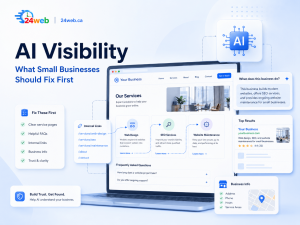
AI search is changing how people find businesses online.
Instead of clicking through a list of blue links, more people now ask full questions and get direct answers. They might search things like “best website support for small businesses,” “who can help fix my Google Ads,” or “local company that updates websites for small businesses.”
When that happens, search tools may summarize the answer instead of just showing a list of websites.
That raises an important question for business owners: how can your business become one of the businesses that gets mentioned?
The good news is that you do not need to be a huge company. In many cases, small businesses can improve their visibility by making their website clearer, more helpful, and easier for search systems to understand.
What AI search results actually mean
AI search results are answers generated by search tools that pull information from websites across the internet. Instead of only showing pages, these systems try to understand the question and provide a useful summary.
That means your website content needs to do more than just exist. It needs to clearly explain:
- what you do
- who you help
- where you work
- why people should trust you
- how to contact you
If your website is vague, outdated, or missing key information, it becomes harder for AI-driven search tools to use it confidently.
Why this matters for small businesses
Small businesses often assume they cannot compete online unless they spend heavily on ads or publish endless content.
That is not always true.
Many AI-driven search experiences are looking for the clearest and most trustworthy answer, not just the biggest brand. A smaller local business with a well-structured website can sometimes be more useful than a larger company with generic content.
In simple terms, if your website explains your services clearly and answers real customer questions, you have a better chance of being found.
1. Make your service pages very clear
One of the biggest mistakes small businesses make is using vague wording.
A visitor should be able to land on your page and understand within seconds:
- what service you offer
- who it is for
- what problem it solves
- what area you serve
For example, instead of a generic page called Services, it is much better to have pages like:
- Website Maintenance for Small Businesses
- Google Ads Management for Local Service Businesses
- Emergency Website Support in Canada
These pages give search engines and AI tools much more context.
Clear pages also help real people. That matters just as much.
2. Answer common customer questions on your website
AI search tools often look for direct, helpful answers.
That is why FAQ-style content can be so useful. Think about the real questions your customers ask before they contact you.
Examples:
- How much does website maintenance cost?
- Do I need Google Ads for my business?
- How quickly can you fix a broken website?
- What is included in monthly website support?
- Is SEO still important if AI search is growing?
When you answer these questions clearly on your site, you create content that is easier to understand, easier to quote, and more useful to both users and search systems.
This does not mean stuffing pages with random FAQs. It means adding relevant questions where they naturally fit.
3. Build pages around real services, not just broad topics
Small businesses often try to rank with very broad pages that say a little bit about everything.
That approach is weaker than creating focused pages around your actual work.
For example, if you offer support, maintenance, landing page edits, and Google Ads help, those should not all live in one vague paragraph. Give each service enough space to stand on its own.
Specific pages help AI systems match your business to more specific searches.
They also help people feel that you actually understand their problem.
4. Use headings that sound like real questions and real answers
A good heading structure makes your content easier to scan and easier to understand.
Instead of writing headings that are clever but unclear, use headings that reflect what people are actually searching for.
Examples of useful headings:
- What Does Website Maintenance Include?
- How Can Google Ads Help a Local Business?
- Why Is My Website Getting Traffic but No Leads?
- What Should Be on a Small Business Homepage?
These kinds of headings send stronger signals than vague phrases like Our Process or Helpful Information.
5. Keep your Google Business Profile updated
Your website is important, but it is not the only place search systems look.
Your Google Business Profile also helps confirm who you are, what you do, where you operate, and how customers describe your business.
Make sure it includes:
- correct business name
- accurate phone number
- current website link
- service categories
- business description
- updated hours
- real photos
- recent reviews
This helps build consistency. When your website and business profile support the same message, your business looks more trustworthy.
6. Show trust signals clearly
AI search tools aim to provide reliable answers. Your website should make it easy to see that your business is real and credible.
Helpful trust signals include:
- real contact information
- service area details
- testimonials
- reviews
- before-and-after examples
- portfolio work
- case studies
- clear pricing or pricing guidance
- years of experience
- fast response promises only if they are true
Even simple trust elements can make a difference. A clean service page with a real name, a real business location, and a clear explanation is stronger than a polished page that says almost nothing.
7. Write in simple language
A lot of small business websites try too hard to sound impressive.
The result is copy that feels vague, inflated, and hard to trust.
AI systems and human visitors both respond better to clear writing.
Instead of:
We provide innovative digital growth solutions tailored to evolving market opportunities
Try:
We help small businesses maintain their websites, fix issues quickly, and run better Google Ads campaigns
That is easier to understand and more useful.
Simple language does not make your business look small. It makes your business look clear.
8. Create location-relevant content where it makes sense
If your business serves specific cities, regions, or provinces, mention that naturally on your site.
For example:
- website support in Montreal
- Google Ads help for Canadian small businesses
- remote webmaster services across Canada
Location relevance can help AI-driven search tools connect your business to people searching by place.
Just avoid creating low-value location pages with nearly identical text. Each page should be useful and specific.
9. Keep your website updated
An outdated website can weaken trust quickly.
If your pages still mention old services, broken links, expired promotions, or outdated branding, that can make your business look less reliable.
Regular updates matter, including:
- checking forms
- updating service descriptions
- replacing outdated screenshots
- reviewing mobile layout
- fixing broken links
- improving page speed
- refreshing old articles
A technically healthy website is easier to trust and easier to use.
10. Publish helpful content around real customer needs
You do not need to publish every day.
But useful articles can strengthen your visibility over time, especially when they answer the kinds of questions your ideal customers already have.
Examples:
- Is Google Ads worth it for local businesses?
- How often should a small business update its website?
- What should be on a service page?
- Why does my site get traffic but no calls?
This type of content supports your main service pages and gives search systems more context about your expertise.
Common mistakes that make businesses harder to find in AI search
Here are a few things that often hold small businesses back:
Being too vague
If your homepage says only “we help businesses grow,” that does not explain enough.
Combining too many services on one page
Specific pages usually perform better than one broad, overloaded page.
Writing for search engines instead of people
If the content feels forced, repetitive, or unnatural, it becomes less useful.
Ignoring local relevance
If you serve a certain area, make that clear.
Letting the website go stale
Even a decent website loses strength if nobody maintains it.
The biggest mindset shift
Trying to show up in AI search results is not really about chasing a trick.
It is about becoming easier to understand.
The businesses that are most likely to appear in AI answers usually do a few things well:
- they explain their services clearly
- they answer real questions
- they show trust signals
- they keep their website current
- they make it easy for both people and search systems to understand what they do
That is good marketing whether AI search is involved or not.
Final thoughts
Small businesses do not need to out-publish huge brands to improve their online visibility.
In many cases, they just need a clearer website, stronger service pages, better structure, and content that answers real customer questions.
If your business is hard to understand online, it is harder to recommend in search.
If your business is clear, useful, and trustworthy, you give yourself a much better chance of showing up when people ask AI-powered search tools for help.
And that is exactly where more online discovery is heading.