Small-business owners are starting to ask a practical new question:
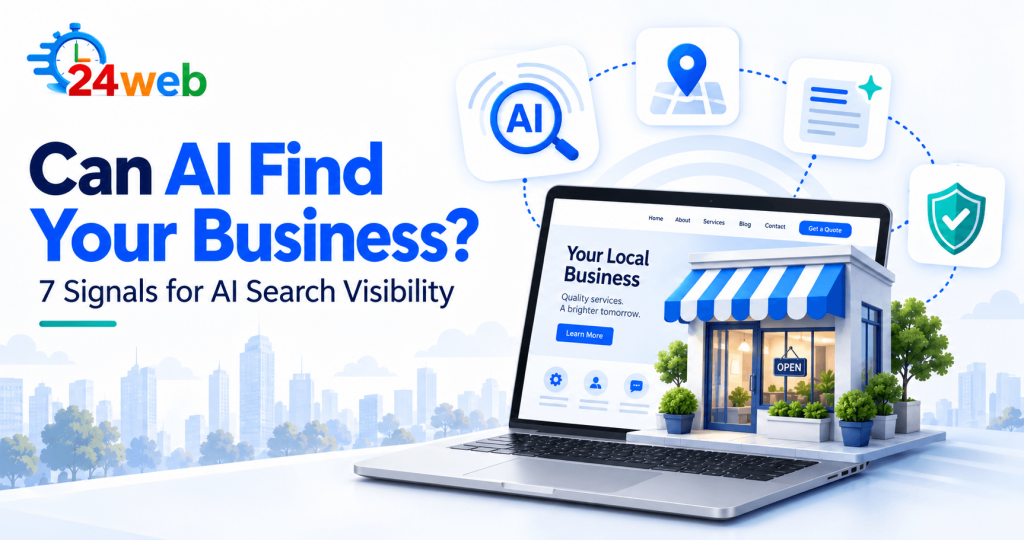
Can customers find my business when they ask an AI assistant for recommendations?
Potential customers may now use an AI-powered search experience to compare local providers, understand a service, choose a product, or decide which business to contact. Traditional SEO still matters, but the standard is getting broader: your website has to communicate clearly enough for search systems to understand what you do, connect it with the right questions, and judge whether the information appears trustworthy.
AI visibility is not about adding more AI-generated content. It is about making your business easier for both people and machines to understand, verify, and trust.
Here are seven practical website signals small businesses should review when thinking about AI search visibility.
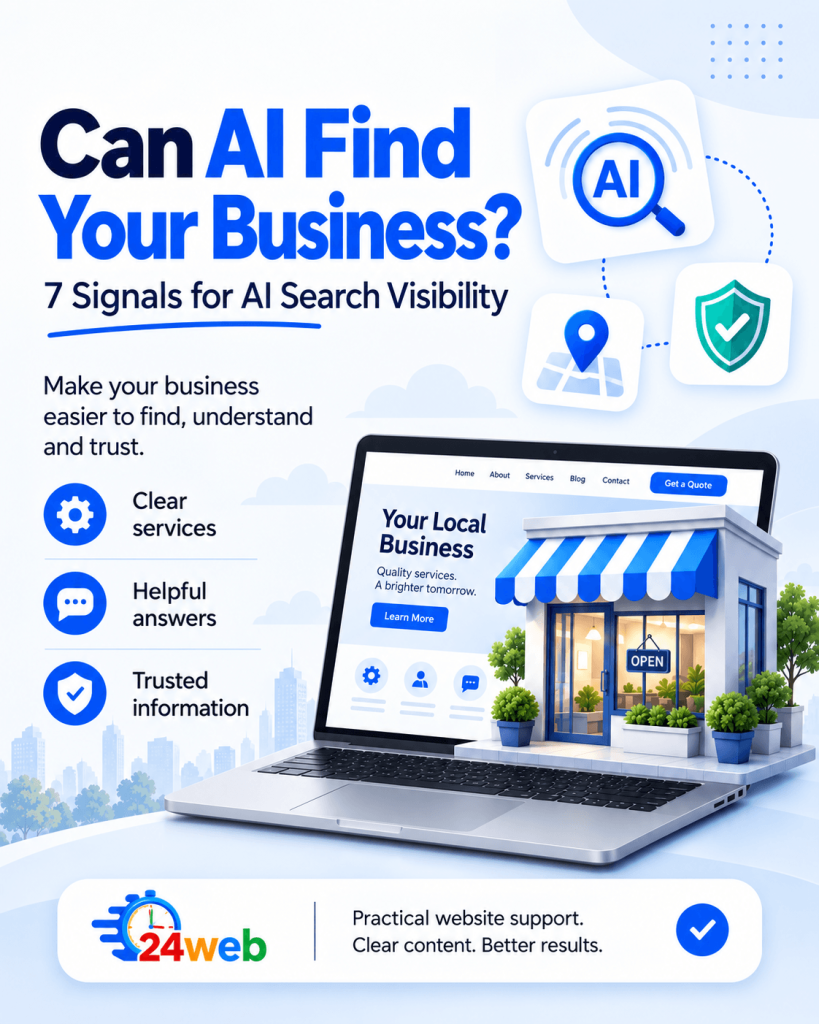
7 AI Visibility Signals at a Glance
| Signal |
What It Helps Clarify |
Quick Check |
| Business identity |
Who you are, what you offer, and where you operate |
Can a new visitor understand your business in under a minute? |
| Service pages |
What each important service includes and who it is for |
Does each core service have enough detail to stand on its own? |
| Customer questions |
Real problems, comparisons, costs, timelines, and next steps |
Do your pages answer the questions people ask before contacting you? |
| Trust signals |
Experience, proof, reviews, examples, authorship, and contact details |
Can a cautious customer verify that the business is credible? |
| Technical foundations |
Crawlability, mobile usability, speed, structured data, and indexing |
Can search systems access and interpret the important pages? |
| Internal links |
How pages, services, articles, and topics relate to one another |
Do useful pages link to other genuinely relevant pages? |
| Updated information |
Accuracy, consistency, and current business details |
Are hours, offers, service areas, and contact details still correct? |
Quick Table of Contents
1. A Clearly Identifiable Business
An AI system should not have to guess who you are, what you offer, or where you operate.
Your website should clearly communicate:
- Your business name
- Your primary services or products
- Your location or service area
- Who you serve
- How customers can contact you
- What makes the business relevant or credible
This information should appear in logical places such as the homepage, About page, Contact page, service pages, and website footer.
Consistency is important. If your website describes the business differently from your Google Business Profile, social accounts, or professional directories, it becomes harder to build a reliable understanding of the business.
For a local company, phrases such as “serving Montreal and surrounding areas” are more informative than a vague statement such as “providing exceptional service everywhere.”
For example, a plumber’s website should make the service area, emergency availability, licensing signals, and main services obvious. A clinic should clearly show its practitioners, appointment process, accepted patients, location, and contact options. These details help people first, and they also reduce ambiguity for search systems.
The goal is not to repeat the same paragraph throughout the website. The goal is to create a consistent and verifiable business identity.
2. Dedicated Pages for Important Services
Many small-business websites describe every service in one short section on the homepage. That may look clean, but it often provides too little information for customers or search systems.
If a service is important enough that someone might search for it independently, it may deserve its own page.
A useful service page should explain:
- What the service includes
- Who it is intended for
- What problem it solves
- What the process looks like
- Where the service is available
- What customers should do next
- Common questions or limitations
For example, a business offering website maintenance, SEO assistance, and analytics setup should not assume that one generic “Digital Services” page clearly explains all three.
A Shopify store might need separate pages for product categories, shipping information, returns, sizing, and common buying questions. A local accountant might need distinct pages for bookkeeping, tax preparation, payroll support, and business advisory work. Each page should answer a different customer need.
Dedicated pages create stronger context. They also give the website more appropriate destinations for internal links, search results, and AI-generated recommendations.
However, this does not mean creating dozens of nearly identical pages. Every page should have a distinct purpose and provide genuinely useful information.
3. Content That Answers Real Customer Questions
AI-powered search is strongly oriented toward questions, comparisons, and explanations.
People ask things such as:
- How much does this service usually cost?
- How long does it take?
- Is it suitable for my situation?
- What happens if I stop maintaining my website?
- Do I need a redesign or only a repair?
- What should I check before hiring someone?
A useful website answers these questions directly and honestly through service-page explanations, FAQs, blog articles, case studies, comparison guides, troubleshooting resources, clear policies, and process descriptions.
A blog article should not exist merely to target a keyword. It should resolve a genuine uncertainty that a prospective customer has.
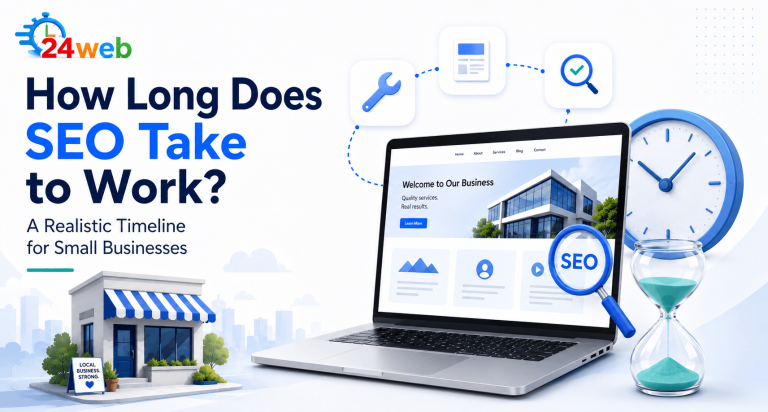
For example, an article explaining
how long SEO takes to work addresses a question that business owners regularly ask before deciding whether an SEO investment is realistic.
The same idea applies outside SEO. A clinic might explain what to expect before a first appointment. A contractor might explain how estimates work. A retailer might explain delivery timelines and return limits. Useful answers reduce hesitation and make the business easier to understand.
Specific, experience-based answers are more useful than generic content that could have been published by any business in any industry.
4. Evidence of Experience and Trust
A website can make many claims. Trust grows when those claims are supported by evidence.
Useful trust signals include:
- Real information about the person or company
- Relevant experience
- Specific examples of completed work
- Before-and-after explanations
- Client reviews
- Clear contact information
- Transparent policies
- Accurate dates and authorship
- Original observations based on real projects
Case studies do not need to disclose confidential information. A concise problem-action-result format can demonstrate how you think and work without identifying the client.
Problem: A form appeared to work but stopped delivering enquiries.
Action: The configuration, mail delivery, and tracking were tested.
Result: Enquiries began reaching the correct inbox, and successful submissions became measurable.
This is more informative than saying, “We deliver outstanding digital solutions.”
Trust also depends on website condition. Broken pages, outdated copyright information, inconsistent branding, and forms that do not work can weaken confidence before a visitor ever makes contact.
5. Strong Technical Foundations
Excellent content cannot perform properly if search systems cannot reliably access and interpret the website.
Important technical foundations include:
- Pages that can be crawled and indexed
- Logical navigation
- Descriptive page titles and headings
- Clean internal linking
- Mobile-friendly layouts
- Reasonable loading performance
- Secure HTTPS delivery
- Accurate canonical URLs
- Working structured data where appropriate
- XML sitemaps
- No accidental noindex directives
- No important content hidden behind broken scripts
Structured data can help search systems interpret details such as the organization, local business, products, articles, breadcrumbs, and frequently asked questions. It does not guarantee rankings or AI citations, but it can make page information more explicit.
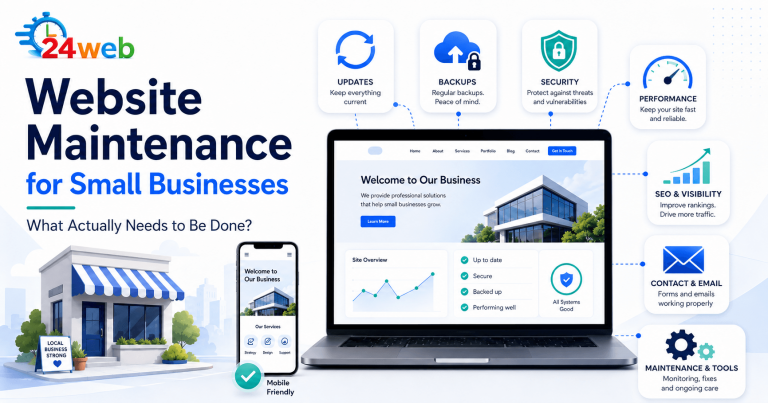
Technical maintenance is not a one-time task. Theme changes, plugin updates, deleted products, and content edits can gradually introduce problems. This is why ongoing
website maintenance for small businesses supports both usability and search visibility.
6. Helpful Internal Links and Clear Relationships
Internal links show how the different parts of a website relate to one another.
A blog post about website security might naturally link to a maintenance service. A local delivery page might link to the relevant product collections. An article about SEO timelines might point visitors toward a website assessment.
Good internal links help:
- Visitors discover related information
- Search engines find important pages
- Establish relationships between topics
- Prevent useful older content from becoming isolated
- Guide potential customers toward an appropriate next step
Anchor text should describe the destination. “Learn more about website maintenance” is more useful than repeatedly using “click here.”
Internal linking should also be selective. Adding a link to every possible keyword can make an article difficult to read and reduce the value of the links that genuinely matter.
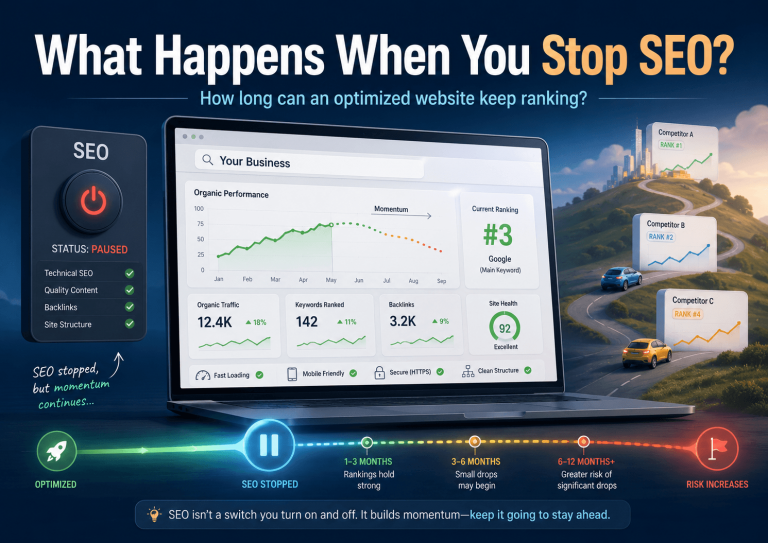
Older content should be reviewed periodically. If optimization work stops entirely, rankings and usability may not disappear immediately, but technical issues, changing competition, and outdated information can gradually weaken performance. This is explored further in
What Happens When You Stop SEO?
AI systems and search engines need dependable information. Customers do too.
Review important website details regularly, including:
- Business hours
- Service areas
- Product availability
- Pricing or starting prices
- Contact information
- Staff and company details
- Shipping and return policies
- Seasonal offers
- Statistics and dated claims
- Links to external resources
An outdated website can continue to attract visitors while giving them incorrect information. That creates a particularly damaging type of visibility: the business is found, but it is misunderstood.
Updating a website does not mean changing content simply to make pages appear fresh. Meaningful updates should improve accuracy, usefulness, or clarity.
SEO, AEO and GEO: Do Small Businesses Need Three Strategies?
Terms such as SEO, AEO, and GEO are increasingly used to describe different forms of search visibility. SEO refers to search engine optimization, AEO refers to answer engine optimization, and GEO usually refers to generative engine optimization.
For most small businesses, treating them as three completely separate strategies creates unnecessary complexity.
The practical foundations still overlap:
- Publish accurate and helpful information
- Use clear page structure
- Answer real questions
- Demonstrate experience and trust
- Make important pages technically accessible
- Connect related content
- Maintain consistent business information
Google’s official Search Central guidance on
optimizing for generative AI in Google Search points site owners back toward strong content and established SEO foundations rather than a secret set of AI-only tactics.
If you want a practical small-business checklist, 24WEB’s guide to
getting a website ready for AI search gives you a simpler starting point.
The labels may change, but the underlying requirement remains: a website must be understandable, useful, and credible.
How Can You Measure AI Search Visibility?
Measuring AI visibility is still developing.
Traditional tools such as Google Search Console and Google Analytics remain important for understanding:
- Search impressions
- Search queries
- Landing pages
- Organic clicks
- Engagement
- Form submissions
- Calls and other conversions
When AI-specific reporting is available in Search Console, it can provide additional context about how website content appears in generative search experiences. Availability and report details may evolve, so verify the current interface and official Google documentation before relying on exact report names or metrics.
Referral traffic from AI platforms may also appear in analytics, although it represents only part of the overall picture.
Do not judge success solely by whether one AI tool mentions the business in one manually tested question. AI answers can vary by wording, location, context, and time.
The more meaningful question is whether the website consistently communicates accurate information and attracts relevant visitors who take useful actions.
What to Check Monthly
- Review Google Search Console for changes in impressions, clicks, queries, and top landing pages.
- Check analytics for organic traffic quality, form submissions, calls, and other meaningful actions.
- Look for new customer questions that deserve clearer answers on service pages or blog posts.
- Confirm that important business details, service areas, hours, and contact options are still accurate.
- Scan for broken links, outdated pages, slow pages, or technical issues that could weaken trust.
- Review AI and referral traffic cautiously, treating it as one signal rather than the whole picture.
A Seven-Point AI Visibility Check
Ask these questions about your website:
- Can a new visitor immediately understand what the business does?
- Does every important service or product category have enough useful information?
- Does the website answer real customer questions?
- Are business claims supported by experience, examples, or reviews?
- Can search systems crawl and interpret the important pages?
- Do internal links connect related information logically?
- Is the business information accurate and consistent?
If several answers are “no” or “I’m not sure,” the priority should not be producing large volumes of AI-generated content.
The priority should be strengthening the website itself.
Build for Understanding, Not Just Rankings
AI-powered discovery is changing how people search, but a trustworthy website remains the foundation.
Small businesses do not need to chase every new acronym or rebuild their entire website whenever search technology changes. They need clear services, useful content, technical reliability, and credible information.
These improvements support traditional search, AI-driven discovery and, most importantly, the people deciding whether to trust the business.
A website that is easy to understand is also easier to recommend.
FAQ
What is AI search visibility?
AI search visibility describes how clearly and accurately a business, website, or piece of content can be discovered, interpreted, and potentially referenced in AI-powered search experiences. It depends on content quality, technical accessibility, trust, relevance, and consistent business information.
Is AI search optimization different from traditional SEO?
There are differences in how information may be presented and measured, but the foundations overlap considerably. Clear content, useful answers, crawlable pages, internal links, trustworthy information, and strong technical SEO support both traditional and AI-powered search.
Can I guarantee that ChatGPT or Google AI will recommend my business?
No. No legitimate consultant can guarantee that a specific AI system will mention or recommend a business. Responses may change depending on the user’s wording, location, available sources, context, and the system being used.
Do I need to create AI-generated content to appear in AI search?
No. Using AI to produce content does not automatically improve AI visibility. Original expertise, accurate information, useful explanations, and clear website structure are more important than whether AI assisted with the writing.
Does structured data guarantee visibility in AI answers?
No. Structured data can help search systems interpret page information, but it does not guarantee rankings, rich results, or inclusion in AI-generated answers. It should accurately represent content that visitors can also see on the page.
How can a small business improve its AI visibility?
Start by clearly describing the business and its services, creating useful pages, answering customer questions, demonstrating experience, improving technical accessibility, strengthening internal links, and keeping information current.
How long does AI search optimization take?
There is no universal timeline. Technical fixes may be processed relatively quickly, while stronger authority, content coverage, and trust normally develop over time. Avoid promising a fixed result or guaranteed AI citation.
Not Sure How Clearly Your Website Communicates With Customers and Search Systems?
Find out whether your business is clear to customers, Google, and AI-powered search tools. I can review its content, structure, technical foundations, and tracking, then explain what is worth improving first.
Request a Website Check